-
目录
-
spring-boot-starter-*是官方的命名规范,其他第三方依赖thirdpartyproject-spring-boot-starter -
classpath等价于main/java + main/resources+ 第三方 jar 包的根目录 -
classpath*:不仅包含 class 路径,还包括 jar 文件中(class路径)进行查找。而且不仅限于 classes 当前目录下,也会对其子目录进行搜索。 -
file:作为URL从文件系统中加载,这种方式通常配置相对路径,相对于当前 jar 包所在路径。另外file:///通常表示的是本地文件的绝对路径
Spring
@Value不能注入static字段,可通过setter方法注入
// yml文件:config.jwt.expire: 1000 * 60 * 60 * 24 * 7
public static long expire; // 过期时间,单位毫秒
public static String secret; // 密钥长度≥4
// #用于注入Spel表达式,$是占位符,字符串替换
("#{${config.jwt.expire}}")
public void setExpire(long expire){
JwtUtils.expire = expire;
}
("${config.jwt.secret}")
public void setSecret(String secret){
JwtUtils.secret = secret;
}
note
类上需有 @Component 注解,将类交由 Spring 容器管理
- 获取 IoC 容器(其实就是 ApplicationContext)
GenericApplicationContext context = new GenericApplicationContext();
new XmlBeanDefinitionReader(context).loadBeanDefinitions("services.xml", "daos.xml");
context.refresh();
important
当你创建一个Bean定义时,你创建了一个“配方”,用于创建该Bean定义(definition)是所定义的类的实际实例
-
在容器本身中,这些Bean定义被表示为 BeanDefinition 对象,它包含(除其他信息外)以下元数据。
- 一个全路径类名:通常,被定义的Bean的实际实现类。
- Bean的行为配置元素,它说明了Bean在容器中的行为方式(scope、生命周期回调,等等)。
- 对其他Bean的引用,这些Bean需要做它的工作。这些引用也被称为合作者或依赖。
- 要在新创建的对象中设置的其他配置设置——例如,pool的大小限制或在管理连接池的Bean中使用的连接数。
-
当容器被创建时,Spring容器会验证每个Bean的配置。然而,在实际创建Bean之前,Bean的属性本身不会被设置。当容器被创建时,那些具有单例作用域并被设置为预实例化的Bean(默认)被创建。作用域在 Bean Scope 中定义。否则,Bean只有在被请求时才会被创建。
-
默认情况下,ApplicationContext 的实现会急切地创建和配置所有的 单例 Bean,作为初始化过程的一部分。一般来说,这种预实例化是可取的,因为配置或周围环境中的错误会立即被发现。懒加载的 bean 告诉IoC容器在第一次被请求时创建一个bean实例,而不是在启动时。这种行为是由 元素上的 lazy-init 属性控制的,
<bean id="lazy" class="com.something.ExpensiveToCreateBean" lazy-init="true"/>
| Scope | 说明 |
|---|---|
| singleton | (默认情况下)为每个Spring IoC容器将单个Bean定义的Scope扩大到单个对象实例。 |
| prototype | 将单个Bean定义的Scope扩大到任何数量的对象实例。 |
| request | 将单个Bean定义的Scope扩大到单个HTTP请求的生命周期。也就是说,每个HTTP请求都有自己的Bean实例,该实例是在单个Bean定义的基础上创建的。只在Web感知的Spring ApplicationContext 的上下文中有效。 |
| session | 将单个Bean定义的Scope扩大到一个HTTP Session 的生命周期。只在Web感知的Spring ApplicationContext 的上下文中有效。 |
| application | 将单个Bean定义的 Scope 扩大到 ServletContext 的生命周期中。只在Web感知的Spring ApplicationContext 的上下文中有效。 |
| websocket | 将单个Bean定义的 Scope 扩大到 WebSocket 的生命周期。仅在具有Web感知的 Spring ApplicationContext 的上下文中有效。 |
-
为了与容器对Bean生命周期的管理进行交互,你可以实现Spring InitializingBean 和 DisposableBean 接口
-
为同一个Bean配置的多个生命周期机制,具有不同的初始化方法,其调用方式如下。
- 注解了 @PostConstruct 的方法。
- afterPropertiesSet(),如 InitializingBean 回调接口所定义。
- 一个自定义配置的 init() 方法。
- 销毁方法的调用顺序是一样的。
- 注解了 @PreDestroy 的方法。
- destroy(),正如 DisposableBean 回调接口所定义的那样。
- 一个自定义配置的 destroy() 方法。
- 注解了 @PostConstruct 的方法。
-
当类A实现ApplicationContextAware接口时,Spring的ApplicationContext会在该类实例化之后,自动将自己(即整个应用上下文ApplicationContext)的引用注入到这个类中
public class MyBean implements ApplicationContextAware {
private ApplicationContext context;
public void setApplicationContext(ApplicationContext applicationContext) throws BeansException {
this.context = applicationContext;
}
// 使用context来获取其他Bean或配置信息
-
当Spring创建了一个实现了 BeanNameAware 接口的对象时,它会自动为这个对象提供一个指向该对象在容器中定义的名字的引用。这样,该对象就可以知道自己在Spring容器中的名字,并根据这个名字来做相应的处理。
-
Spring还提供了一系列的 Aware 回调接口,让Bean向容器表明它们需要某种基础设施的依赖性。一般来说,名称表示依赖关系的类型
-
当你需要向容器索取一个实际的 FactoryBean 实例而不是它产生的Bean时,在调用 ApplicationContext 的
getBean()方法时,在 Bean 的id前加上安培符号(&)。因此,对于一个id为myBean的FactoryBean,在容器上调用getBean("myBean")会返回FactoryBean的产物,而调用getBean("&myBean")会返回FactoryBean实例本身。 -
Spring BeanPostProcessor 在幕后使用一个 ConversionService 来处理将 @Value 中的 String 值转换为目标类型的过程。如果你想为你自己的自定义类型提供转换支持,你可以提供你自己的 ConversionService Bean实例,如下例所示。
public class AppConfig {
public ConversionService conversionService() {
DefaultFormattingConversionService conversionService = new DefaultFormattingConversionService();
conversionService.addConverter(new MyCustomConverter());
return conversionService;
}
}
事件
- 某些事件是在
ApplicationContext创建之前就被触发了,不能在这些事件上注册监听器,可以通过SpringApplication.addListeners(…)和SpringApplicationBuilder.listeners(…)创建。还可以在META-INF/spring.factories中添加监听器org.springframework.context.ApplicationListener=com.example.project.MyListener - 程序运行时的事件发生顺序:
ApplicationStartingEvent:在运行时的任何进程之前发生,除了监听器和初始化器除外ApplicationEnvironmentPrepareEvent:当Environment在Context已知但尚未创建之前使用的时候ApplicationContextInitializedEvent:当ApplicationContext准备好,并且ApplicationContextInitializers被调用但任何bean的定义被加载之前ApplicationPreparedEvent:仅在refresh开始前且bean的定义加载后ApplicationStartedEvent:在context刷新之后,且任何application和command-line runners调用之前AvailabilityChangeEvent:在LivenessState.CORRECT指明应用存活之后ApplicationFailedEvent:有在启动阶段有异常发生之后WebServerInitializedEvent:WebServer就绪。ContextRefreshedEvent:当ApplicationContext刷新之后
note
- 启动期间运行的任务应由
CommandLineRunner和ApplicationRunner组件执行,而不是使用 Spring 组件生命周期回调,如@PostConstruct。 - 事件侦听器不应运行可能很长的任务,因为默认情况下它们在同一线程中执行。考虑改用
CommandLineRunner和ApplicationRunner。
- 通过注入
ApplicationArguments访问传递给main函数的参数String[] args - 如果你需要在 SpringApplication 启动后运行一些特定的代码,使用
CommandLineRunner和ApplicationRunner接口。非常适合在应用程序启动后但在开始接受流量之前运行的任务。他们中声明了一个run方法。多个实现的话需要org.springframework.core.Ordered接口或org.springframework.core.annotation.Order注解指定顺序。 - 通过 ApplicationStartup` 来跟踪 Springboot 启动的过程。
import org.springframework.boot.SpringApplication;
import org.springframework.boot.autoconfigure.SpringBootApplication;
import org.springframework.boot.context.metrics.buffering.BufferingApplicationStartup;
public class MyApplication {
public static void main(String[] args) {
SpringApplication application = new SpringApplication(MyApplication.class);
application.setApplicationStartup(new BufferingApplicationStartup(2048));
application.run(args);
}
}
FlightRecorderApplicationStartup可以记录 JVM 事件,例如分配,GC,类加载,java -XX:StartFlightRecording:filename=recording.jfr,duration=10s -jar demo.jar记录
属性值配置
- 外部配置源包括 properties, YAML, environment variables, command-line arguments.
- 各个配置源顺序,后者可覆盖前者配置的值
- 默认属性
SpringApplication.setDefaultProperties @PropertySource注解,用在@Configuration的类上。不能用在Environment上application.propertiesRandomValuePropertySource的属性仅为random.*。- 操作系统环境变量
- Java 系统属性
System.getProperties() - JNDI 属性:
java:com/env ServletContext初始化参数ServletConfig初始化参数- 来自
SPRING_APPLICATION_JSON的属性(嵌入在环境变量或系统属性中的内联 JSON)。 - 命令行参数
test中的properties属性,@DynamicPropertySource、@TestPropertySource- 当 Devtools 处于活动状态时,
$HOME/.config/spring引导目录中的 Devtools 全局设置属性。 - jar 包中的
application.properties和 YAML (properties优先于 YAML) - jar 包中的
application-{profile}.properties和 YAML - jar 包外的
application.properties和 YAML - jar 包外的
application-{profile}.properties和 YAML - 命令行参数,将
--server.port=9000转换为properties并添加到Spring Environment,SpringApplication.setAddCommandLineProperties(false)禁止添加到Spring Environment - 使用json:
my.name=test等价于$ java -Dspring.application.json='{"my":{"name":"test"}}' -jar myapp.jar和$ java -jar myapp.jar --spring.application.json='{"my":{"name":"test"}}'java -Dspring.xxx -jar xxx.jarD 用于配置系统属性(JVM属性),这些属性可以在 Java 应用程序中通过System.getProperty()方法获取java -jar xxx.jar --spring.xxx用于直接传递应用程序的配置参数,使用@Value或environment.getProperty("spring.profiles.active")获取
- 默认属性
- 搜索配置文件:从类路径的根目录、类路径的
/config包、当前目录、当前目录的config/子目录、config/子目录的直接子目录 - 修改配置文件名为
myproject.properties:$ java -jar myproject.jar --spring.config.name=myproject - 指定配置文件位置,多个用逗号分隔:
$ java -jar myproject.jar --spring.config.location=optional:classpath:/default.properties, optional:classpath:/override.properties,使用前缀optional:如果位置是可选的,并且您不介意它们不存在。 application.properties使用#--- or !---区分多个配置环境- 随机值
my
secret"${random.value}"
number"${random.int}"
bignumber"${random.long}"
uuid"${random.uuid}"
number-less-than-ten"${random.int(10)}"
number-in-range"${random.int[1024,65536]}"
-
ApplicationContext是BeanFactory的子接口,BeanFactory提供了配置框架和基础功能,ApplicationContext提供了更多企业特定功能。 -
在
Spring中,构成应用程序骨干并由Spring IoC容器管理的对象称为bean,bean是由Spring IoC容器实例化、组装和管理的对象。 -
容器通过读取配置元数据来获取关于实例化、配置和组装哪些对象的指令。配置元数据以XML、Java注释或Java代码表示。它允许您表达组成应用程序的对象以及这些对象之间丰富的相互依赖关系。
-
在容器本身中,这些
bean定义表示为BeanDefinition对象,其中包含(除其他信息外)以下元数据:- 包限定类名:通常是定义的
bean的实际实现类。 - Bean 行为配置元素,说明 Bean 在容器中的行为方式(作用域、生命周期回调等)。
- 对 bean 工作所需的其他 bean 的引用。这些引用也称为协作者或依赖关系。
- 在新创建的对象中设置的其他配置设置,例如,池的大小限制或管理连接池的 bean 中使用的连接数。
- 包限定类名:通常是定义的
-
依赖注入:对象定义依赖关系有以下几种方式:
- 构造函数中引用别的对象
- 工厂函数
- 作为类的属性
-
当创建
bean的时候容器注入这些依赖,而不用显示的去初始化等操作,也不需要指定类的位置,解耦程序
// 直接创建对象,耦合度高
class A{
B b = new B();
}
// 依赖注入,通过构造函数,此时A不需要关注如何创建对象,只需要会使用就可以
class A{
private B b;
// 使用 spring 直接注入
A(B b){
this.b = b;
}
}
note
- 注入的方式有两种:基于注解和基于xml的
bean就是已经初始化的对象,交给容器管理bean在被注入前肯定是一个完备的状态- 由于可以混合使用基于构造函数和基于设置器的DI,因此将构造函数用于强制依赖关系,将 setter 方法或配置方法用于可选依赖关系是一个很好的经验法则。
-
自动装配有四种模式:
no:默认值,不自动装配byName:容器找与属性同名的bean注入byType:通过类型查找,如果存在多个同类型的bean则发生异常constructor:类似于byType但是通过构造函数注入
-
bean的范围singleton:单例prototype:原型,每次调用applicationContext.getBean都返回不同的实例。spring 不会管理原型bean的生命周期,通常需要自定义bean的销毁方法以清理资源request:在每个请求是单例的session:在每个会话中是单例的application:在一个ServletContext是单例的,ServletContext的范围是整个 Web 应用,其范围大于ApplicationContxtwebsocket:在一个WebSocket周期内是单例的
bean 声明周期
- 容器在
bean初始化和销毁时执行InitializingBean接口的afterPropertiesSet()方法和DisposableBean接口的destory()方法完成指定的操作。或者使用@PostConstruct和@PreDestory注解。还可使用@Bean的initMethod和destroyMethod属性 - 在内部,Spring Framework 使用
BeanPostProcessor实现来处理它能找到的任何回调接口,并调用相应的方法。类似的还有Lifecycle接口
note
bean实例只有在从@PostConstruct方法返回后才被视为完全初始化并准备好发布给其他人。XXXAware接口通常是让bean意识到 XXX 存在,例如ApplicationContextAware接口定义了一个setApplicationContext(ApplicationContext applicationContext)让bean可以获得applicationContext的引用。BeanNameAware获得beanName的引用- 实例化(instantiating)是为对象分配内存
- 初始化(initializing)是设置对象的其他属性,使其成为可使用的状态。
- 如果你想在 Spring 容器完成
bean的实例化、配置和初始化后实现一些自定义逻辑,你可以插入一个或多个自定义BeanPostProcessor接口实现(也是作为一个bean,容器会自动调用其方法)。BeanPostProcessor提供了两种方法来扩展 Spring 的bean生命周期:postProcessBeforeInitialization(Object bean, String beanName): 在bean初始化之前调用。postProcessAfterInitialization(Object bean, String beanName): 在bean初始化之后调用。 - 要更改实际的
bean定义(即定义bean的蓝图),您需要使用BeanFactory PostProcessor接口,PropertyOverrideConfigurer和PropertySourcesPlaceholderConfigurer是预定义的两个子接口 FactoryBean<T>是自定义bean实例化的回调接口,提供三个方法:T getObject()返回对象的实例,boolean isSingleton()返回是否为单例,默认为true,Class<?> getObjectType()返回对象的类型,或null- 当你需要向容器请求实际的
FactoryBean实例本身而不是它生成的bean时,在调用ApplicationContext的getBean()方法时,在bean的id前加上与号(&)。因此,对于id为myBean的给定FactoryBean,在容器上调用getBean("myBean")会返回FactoryBean产生的bean,而调用getBean("&myBean")则返回FactoryBean实例本身。 - 您还可以将
@Autowired用于众所周知的可解析依赖关系的接口:BeanFactory、ApplicationContext、Environment、ResourceLoader、ApplicationEventPublisher和MessageSource。 - 定义在
@Configuration中的@Bean会被 CGLIB 代理,交由容器管理 @Configuration主要目的是作为bean定义的来源。@Configuration配置类允许通过调用同一类中的其他@Bean方法来定义bean之间的依赖关系。- 当
@Bean方法在没有用@Configuration注释的类中声明时,它们被称为以 “lite” 模式处理。 @DependsOn("myBean")注解用于表示当前bean要在myBean初始化完成之后才能开始初始化
事件
-
ContextRefreshedEvent:当ApplicationContext被初始化或刷新时发布此事件。 -
ContextStartedEvent:当通过ConfigurableApplicationContext接口上的start()方法启动ApplicationContext时发布此事件。 -
ContextStoppedEvent:当通过ConfigurableApplicationContext接口上的stop()方法停止ApplicationContext时发布此事件 -
ContextClosedEvent:当通过ConfigurableApplicationContext接口上的close()方法关闭ApplicationContext或者通过 JVM 关闭钩子关闭时发布此事件。 -
RequestHandledEvent:这是一个特定于Web应用的事件,用于告诉所有bean一个 HTTP 请求已被服务。此事件在请求完成后发布。此事件仅适用于使用 Spring 的DispatcherServlet的Web应用程序。 -
ServletRequestHandledEvent:这是RequestHandledEvent的子类,增加了与 Servlet 相关联的上下文信息。这使得事件携带者可以包含更多的细节,如请求和响应对象,这对于某些需要访问请求特定信息的场景非常有用。 -
通过实现
ApplicationListener<ApplicationEvent>接口并重写onApplicationEvent(ApplicationEvent event)方法,开发者可以订阅这些事件并做出相应的处理。 -
bean实现ApplicationListener接口,当事件发布到ApplicationContext时,就会通知bean执行预定义的操作。目前也有基于注解的实现方式,不再需要继承ApplicationEvent。 -
在方法上使用
@EventListener,方法参数中使用ApplicationEvent,或者同时监听多个事件,使用非参数化的方式@EventListener({ContextStartedEvent.class, ContextRefreshedEvent.class})。也可使用条件属性:@EventListener(condition = "#blEvent.content == 'my-event'")。更改方法签名,可以在响应 A 事件后再发布新的 B 事件:BEvent do(AEvent){} -
使用
@Async结合@EventListener发布异步事件 -
使用
@Order(n)确定监听器执行顺序
STOMP
- RabbitMQ中Channel是一个逻辑连接,看成是建立在Connection上的轻量级连接
- MessageHandler 是被 @MessageMapping 标记的方法,客户端发送 send 的 stomp 消息,以 app 为前缀,这个消息会被路由到 MessageHandler,其返回结果会被包装成 Message,发送到消息代理中(app 被替换为 topic),由消息代理将消息广播给所有订阅者(默认情况是替换为
topic,如果需要发送到queue可以使用@SendTo或SimpMessagingTemplate) - SubscribeMapping 注解的方法返回结果是直接发送给客户端,不经过代理
- 使用 sentTo 将消息发送到不同的一个或多个目的地,使用 sendToUser 将消息发送给客户端用户
- 可以在任意地方注入 SimpMessagingTemplate,直接发送消息给客户端,该 bean的名称是 brokerMessagingTemplate
- 消息代理也是一个队列,客户端发送 subscribe 的 stomp,会直接路由到消息代理,其中保存订阅者信息
- 消息代理通过发送 message 的 stomp 向所有订阅者发送消息
- 使用外部的代理,配置一个 StompMessageRelay 代理中继,它通过 tcp 连接将消息发给外部的 rabbitmq,
- 对于用户目的地,用户订阅 /user/queue/greeting,发送消息时:SimpMessagingTemplate.convertAndSendToUser(userid, "/queue/greeting",message),
-
一般订阅topic和queue,不同的消息代理对不同的地址前缀有不同的行为,对于RabbitMQ,参考该连接 https://www.rabbitmq.com/docs/stomp#d
- queue前缀
/queue/<name>:对于SUBSCRIBE帧,会创建一个名为<name>的队列,用于存储订阅者信息。对于SEND帧,只有在第一次发送时才会创建名为<name>的队列,消息被发送到默认交换机(amq.topic)以<name>作为绑定键。可以在发送帧时指定队列的参数,默认创建的是持久化、非排他、非自动删除的队列。 - topic前缀
/topic/<name>:对于SEND帧,消息被发送到默认交换机(amq.topic)以<name>作为路由键。对于SUBSCRIBE帧,创建一个非持久化、自动删除的队列,绑定到默认交换机(amq.topic)以<name>作为路由键。可以在发送帧时指定队列的参数。
- queue前缀
-
对于应用而言,发送SUBSCRIBE时应该使用topic和queue地址,发送SEND帧时,以app为地址。
-
当订阅
/user/queue/position-updates时,代理中继内部的UserDestinationMessageHandler会将该地址转换成/queue/position-updates-user123与用户会话相关联的独一无二的地址,避免订阅通用地址时的冲突问题。 -
客户端发送消息是在@MessageMapping处理,订阅是目的地(destination)
- 场景:zmy点击flm头像,表示要和它聊天,前端开始建立连接,然后订阅私人目的地;
- zmy输入一段文字,点击发送,走到MessageMapping处理,调用chatservice动态生成队列(内部完成消息的监听),使用rabbittemplate将消息发送到交换机,private路由键
- 消息到达监听器,开始处理消息,就是使用messagetemplate将消息发给私有目的地,
- 订阅了私有目的地的用户可以手动消息
- 点击社区,开始建立websocket连接,订阅自己的目的地(目的地不需要建立),点击李四头像,同时建立李四的队列,当用户编辑消息发送时,路由到李四的队列,处理消息时发送
- 全局通知:
- 定向通知:
- 聊天:
- 用户订阅:/queue/private/{userid}, /user/queue/notifaction /topic/notification/all, 登录的时候订阅后两个
-
前端的stompClient应该全局的,放在pinia中
-
两个问题:
-
订阅:/user/exchange/chat
-
发送:/app/privateMessage,数据是MessageDto,后端在发送到/exchange/chat地址,用户flm
-
遇到的问题:订阅/user/exchange,并没有新建队列
-
SimpMessagingTemplate发送非指定用户并没有反应
请求方式
| 注解 | 用途 | 绑定来源 | 典型 Content-Type | 是否支持文件 |
|---|---|---|---|---|
| @RequestParam | 绑定 表单字段 或 URL 查询参数 | application/x-www-form-urlencoded 或 multipart/form-data 中的 字段名 | application/x-www-form-urlencoded, multipart/form-data | ✅ 可绑定 MultipartFile(当字段是文件时) |
| @RequestBody | 绑定 整个请求体 为一个对象(通常 JSON) | 请求体的原始字节流,经 HttpMessageConverter(如 Jackson)反序列化 | application/jsonapplication/xml 等 | ❌ 不支持文件(因为文件不是结构化文本) |
| @RequestPart | 用于 multipart/form-data 中的 复杂部分(如 JSON 对象或文件) | multipart 请求中的某一个 part(可包含 JSON 或二进制) | multipart/form-data | ✅ 支持文件,也支持 JSON part |
-
为什么
@RequestBody和MultipartFile不能共用?- 根本原因:HTTP 请求只能有一个
Content-Type @RequestBody要求请求体是 纯 JSON →Content-Type必须是application/json- 文件上传必须使用
multipart/form-data→ 这是一种多部分混合格式,包含文本字段和二进制数据
- 根本原因:HTTP 请求只能有一个
-
前端传参时使用 FormData,重要:不要手动设置
Content-Type,否则浏览器不会生成正确的boundary,导致后端解析失败。浏览器会自动设置boundary -
Swagger(OpenAPI)常用注解说明
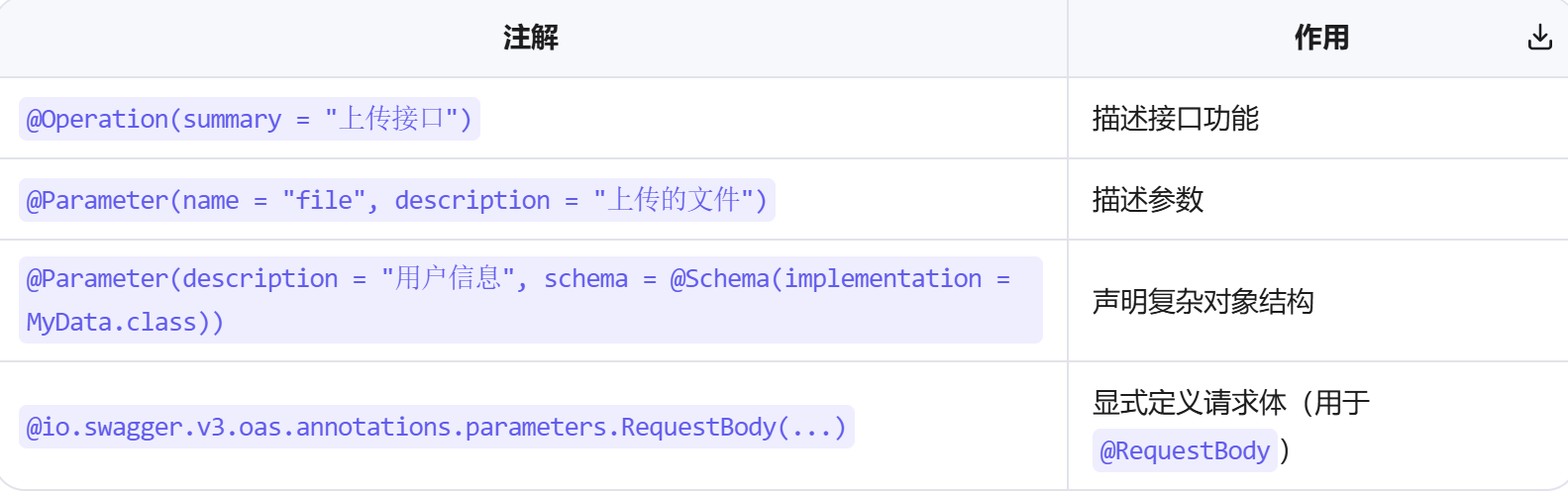
-
@RequestPart 使用方式,用于复杂对象,平常可使用 @RequestParam 接收json字符串,后端转为对象
(value = "/upload", consumes = MediaType.MULTIPART_FORM_DATA_VALUE)
public ResponseEntity<String> upload(
("file") MultipartFile file,
("user") User user) { // ← 关键:直接绑定为对象
System.out.println("文件名: " + file.getOriginalFilename());
System.out.println("用户名: " + user.getName());
System.out.println("年龄: " + user.getAge());
return ResponseEntity.ok("上传成功");
}
public class User {
private String name;
private int age;
// getter/setter/toString
}
// 前端传参
const user = { name: "张三", age: 25 };
// 创建一个 Blob,内容是 JSON 字符串,类型是 application/json
const userBlob = new Blob([JSON.stringify(user)], {
type: 'application/json'
});
const formData = new FormData();
formData.append('file', document.querySelector('#fileInput').files[0]);
formData.append('user', userBlob); // ← 注意:不是 append('user', JSON.stringify(...))
fetch('/api/upload', {
method: 'POST',
body: formData
// 不要设置 headers! 浏览器会自动设置 multipart 和 boundary
});
- 传递数组
// 场景 1️⃣:接收复杂对象集合(如 List<User>)
("/users/batch")
public ResponseEntity<?> createUsers( List<User> users) {
// users 是 List<User>,User 包含 name, age 等字段
return ResponseEntity.ok(users);
}
const users = [
{ name: "张三", age: 25 },
{ name: "李四", age: 30 }
];
// ✅ 前端 AJAX(必须用 JSON)
fetch('/api/users/batch', {
method: 'POST',
headers: { 'Content-Type': 'application/json' },
body: JSON.stringify(users) // ← 整个请求体就是数组
});
// 场景 2️⃣:接收简单类型集合(如 List<Long>、String[])
// 方式 A:作为 查询参数(Query Parameter)
("/users")
public List<User> getUsersByIds( List<Long> ids) {
return userService.findByIds(ids);
}
// 方式1:重复参数名(Spring 默认支持)
fetch('/api/users?ids=1&ids=2&ids=3')
// 方式2:用逗号分隔(需配置)
fetch('/api/users?ids=1,2,3')
方式 B:作为 表单字段(Form Data)
(value = "/delete", consumes = MediaType.APPLICATION_FORM_URLENCODED_VALUE)
public void deleteUsers( List<Long> ids) {
// ...
}
const formData = new URLSearchParams();
formData.append('ids', '1');
formData.append('ids', '2'); // 重复 append
fetch('/api/delete', {
method: 'POST',
headers: { 'Content-Type': 'application/x-www-form-urlencoded' },
body: formData
});
- 新旧版本swagger注解对比
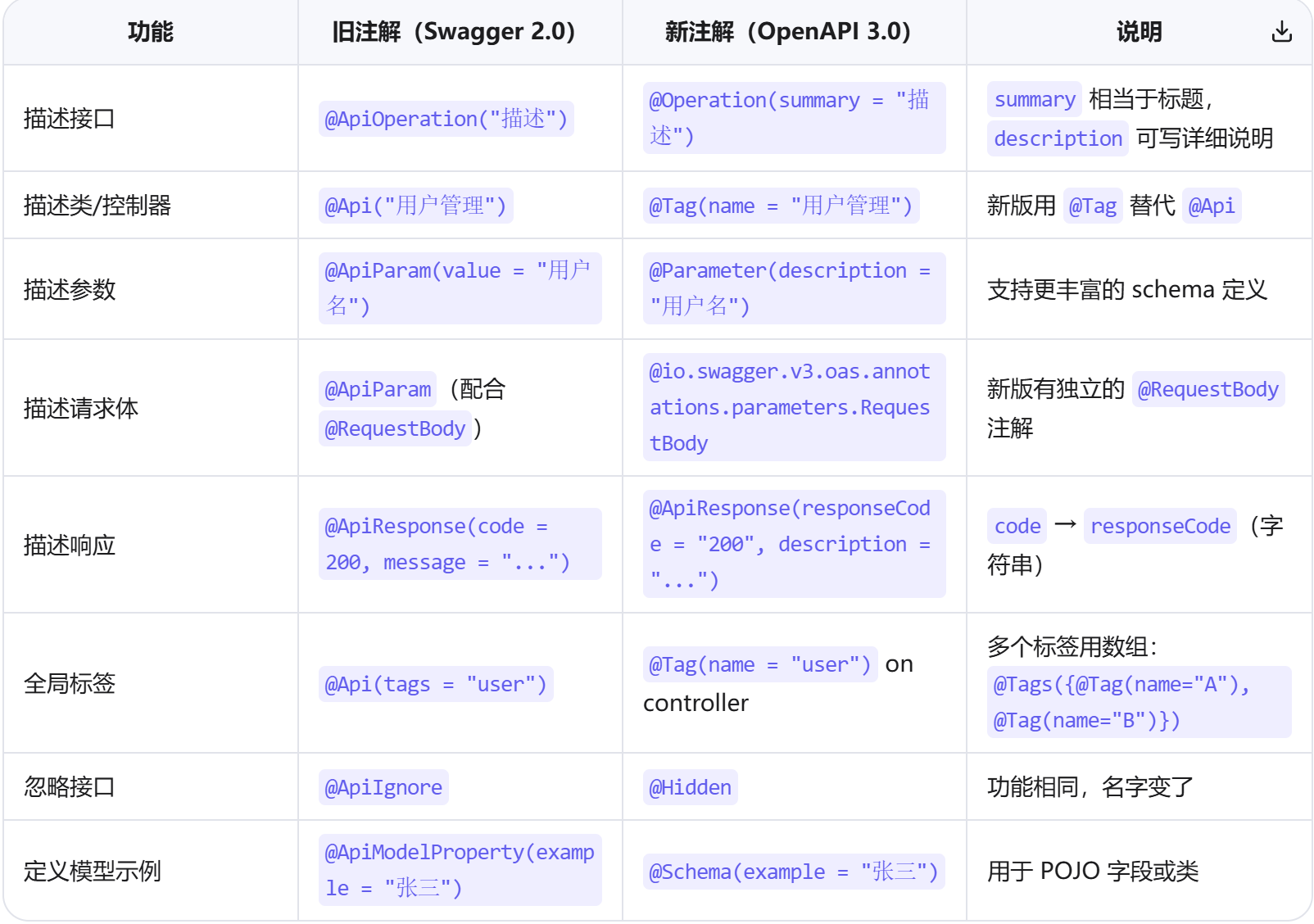
spring 启动过程核心类
spring 扩展点
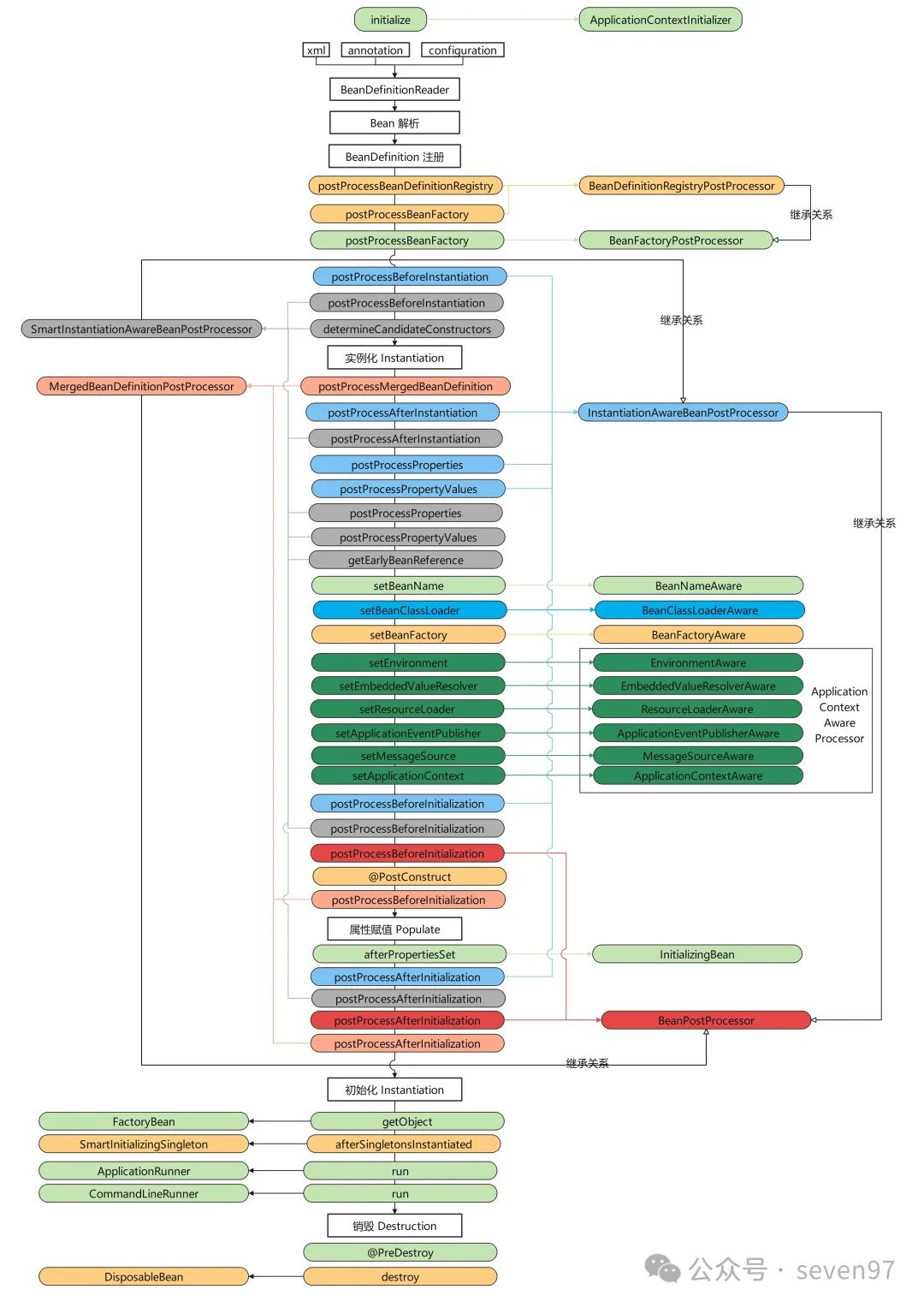

ApplicationContextInitializer
- 在容器刷新refresh之前调用此类的
initialize方法。这个接口的主要目的是在 Spring 应用上下文初始化的早期阶段进行一些配置或调整,以便在上下文加载后可以使用这些配置。
使用场景
- 在应用启动时进行环境配置:可以使用 ApplicationContextInitializer 来在应用上下文初始化时进行一些环境相关的配置,例如设置系统属性、加载外部配置文件等。
public class EnvironmentInitializer implements ApplicationContextInitializer<ConfigurableApplicationContext> {
public void initialize(ConfigurableApplicationContext applicationContext) {
ConfigurableEnvironment environment = applicationContext.getEnvironment();
environment.setActiveProfiles("development");
System.out.println("配置文件设置为development");
}
}
- 注册自定义的 BeanFactoryPostProcessor 或者 BeanPostProcessor:ApplicationContextInitializer 可以用来注册自定义的 BeanFactoryPostProcessor 或者 BeanPostProcessor,以便在 Bean 初始化之前或之后进行某些自定义处理。
public class CustomBeanFactoryPostProcessorInitializer implements ApplicationContextInitializer<ConfigurableApplicationContext> {
public void initialize(ConfigurableApplicationContext applicationContext) {
applicationContext.addBeanFactoryPostProcessor(beanFactory -> {
// 添加自定义的 BeanFactoryPostProcessor
System.out.println("添加了自定义BeanFactory后处理器...");
});
}
}
- 动态地添加 PropertySource:可以在初始化过程中动态地添加 PropertySource,以便后续的 Bean 定义和初始化过程中可以使用这些属性。
public class PropertySourceInitializer implements ApplicationContextInitializer<ConfigurableApplicationContext> {
public void initialize(ConfigurableApplicationContext applicationContext) {
MutablePropertySources propertySources = applicationContext.getEnvironment().getPropertySources();
propertySources.addFirst(new MapPropertySource("customPropertySource", Collections.singletonMap("customKey", "customValue")));
System.out.println("已添加自定义属性源");
}
}
Spring环境下添加扩展点
- 在Spring环境下自定义实现一个ApplicationContextInitializer让并且它生效的方式有三种:
// 1. 手动调用的setXXX方法添加
ClassPathXmlApplicationContext context = new ClassPathXmlApplicationContext();

// Add initializer
context.addApplicationListener(new TestApplicationContextInitializer());
// Set config locations and refresh context
context.setConfigLocation("classpath:applicationContext.xml");
context.refresh();

// Use the context
// ...
context.close();

// 2. Spring 的 XML 配置文件中注册
<context:initializer class="com.seven.springsrpingbootextentions.extentions.TestApplicationContextInitializer"/>

// 3. web.xml 文件配置
<context-param>
    <param-name>contextInitializerClasses</param-name>
    <param-value>com.seven.springsrpingbootextentions.extentions.TestApplicationContextInitializer</param-value>
</context-param>
SpringBoot环境下添加扩展点
- 示例,展示了如何实现一个ApplicationContextInitializer来添加一个自定义的属性源:
public class TestApplicationContextInitializer implements ApplicationContextInitializer<ConfigurableApplicationContext> {
public void initialize(ConfigurableApplicationContext applicationContext) {
MutablePropertySources propertySources = applicationContext.getEnvironment().getPropertySources();
// 创建自定义的属性源
Map<String, Object> customProperties = new HashMap<>();
customProperties.put("custom.property", "custom value");
MapPropertySource customPropertySource = new MapPropertySource("customPropertySource", customProperties);
// 将自定义属性源添加到应用程序上下文的属性源列表中
propertySources.addFirst(customPropertySource);
}
}
- 在SpringBoot中让它生效的方式也有三种:
// 在启动类中用springApplication.addInitializers(new TestApplicationContextInitializer())语句加入
public class MySpringExApplication {
public static void main(String[] args) {
SpringApplication application = new SpringApplication(MySpringExApplication.class);
application.addInitializers(new TestApplicationContextInitializer()); // 直接在SpringApplication中添加
application.run(args);
}
}
// 2. application配置文件 配置 com.seven.springsrpingbootextentions.extentions.TestApplicationContextInitializer
# application.yml文件
context:
initializer:
classes: com.seven.springsrpingbootextentions.extentions.TestApplicationContextInitializer
// 3. Spring SPI扩展,在spring.factories中加入(官方推荐):
com.seven.springsrpingbootextentions.extentions.TestApplicationContextInitializer
BeanFactoryPostProcessor
- 这个接口是BeanFactory的扩展接口,调用时机在spring在读取beanDefinition信息之后,实例化bean之前。虽然此时不能再注册BeanDefinition,但是可以趁着bean没有实例化,可以修改 Spring 容器启动时修改其内部的 BeanDefinition。通过实现 BeanFactoryPostProcessor 接口,开发者可以在 Bean 实例化之前修改 Bean 的定义元数据,例如Scope、依赖查找方式、初始化方法、修改属性值、添加额外的元数据等,进而影响初始化行为。同时记住不要在这里做Bean的实例化。
使用场景
- 修改 Bean 属性:可以动态地改变某些配置属性或者注入额外的依赖。
public class PropertyModifierBeanFactoryPostProcessor implements BeanFactoryPostProcessor {
public void postProcessBeanFactory(ConfigurableListableBeanFactory beanFactory) throws BeansException {
BeanDefinition beanDefinition = beanFactory.getBeanDefinition("myBean");
MutablePropertyValues propertyValues = beanDefinition.getPropertyValues();
propertyValues.addPropertyValue("propertyName", "newValue");
}
}
- 动态注册 Bean:可以根据配置文件或者系统环境变量来决定是否注册某个 Bean。
public class ConditionalBeanRegistrar implements BeanFactoryPostProcessor {
public void postProcessBeanFactory(ConfigurableListableBeanFactory beanFactory) throws BeansException {
if (someCondition()) {
BeanDefinitionBuilder beanDefinitionBuilder = BeanDefinitionBuilder.genericBeanDefinition(MyBean.class);
beanFactory.registerBeanDefinition("myConditionalBean", beanDefinitionBuilder.getBeanDefinition());
}
}
private boolean someCondition() {
// 自定义条件逻辑
return true;
}
}
- 修改 Bean 定义:可以修改 Bean 的作用域、初始化和销毁方法等定义信息。
public class ScopeModifierBeanFactoryPostProcessor implements BeanFactoryPostProcessor {
public void postProcessBeanFactory(ConfigurableListableBeanFactory beanFactory) throws BeansException {
BeanDefinition beanDefinition = beanFactory.getBeanDefinition("myBean");
beanDefinition.setScope(BeanDefinition.SCOPE_PROTOTYPE);
}
}
- 属性占位符替换:可以使用 PropertyPlaceholderConfigurer 实现 BeanFactoryPostProcessor 接口,来替换 Bean 定义中的属性占位符。
public class CustomPropertyPlaceholderConfigurer extends PropertyPlaceholderConfigurer {
protected void processProperties(ConfigurableListableBeanFactory beanFactory, Properties props)
throws BeansException {
super.processProperties(beanFactory, props);
// 自定义属性处理逻辑
}
}
- 其它使用场景:
- 配置中心集成:当需要从外部配置中心(如 Spring Cloud Config 或 Apache Zookeeper)动态加载配置并修改 Bean 定义时,可以使用 BeanFactoryPostProcessor。
- 多环境支持:根据不同的环境(如开发、测试、生产环境)动态修改 Bean 的定义,确保不同环境下的 Bean 配置有所不同。
- 动态注册 Bean:在应用运行时,根据条件动态注册或者取消 Bean,比如在某些特定条件下才需要注册某些 Bean。
- 复杂业务应用:有时候会需要根据复杂的业务规则动态调整 Bean 的配置,这时候 BeanFactoryPostProcessor 非常有用。
BeanDefinitionRegistryPostProcessor
- BeanDefinitionRegistryPostProcessor为容器级后置处理器。容器级的后置处理器会在Spring容器初始化后、刷新前执行一次,用于动态注册Bean到容器。BeanDefinitionRegistryPostProcessor用于在bean解析后实例化之前通过BeanDefinitionRegistry对BeanDefintion进行增删改查。
使用场景
- 修改现有的 BeanDefinition:可以在 Bean 实例化之前修改现有的 BeanDefinition,如更改其属性值或作用域。
public class BeanDefinitionModifier implements BeanDefinitionRegistryPostProcessor {
public void postProcessBeanDefinitionRegistry(BeanDefinitionRegistry registry) throws BeansException {
System.out.println("在 postProcessBeanDefinitionRegistry 中修改现有的 BeanDefinition");
if (registry.containsBeanDefinition("myExistingBean")) {
BeanDefinition beanDefinition = registry.getBeanDefinition("myExistingBean");
MutablePropertyValues propertyValues = beanDefinition.getPropertyValues();
propertyValues.add("propertyName", "newValue");
}
}
public void postProcessBeanFactory(ConfigurableListableBeanFactory beanFactory) throws BeansException {
// 此方法可以留空或用于进一步处理
}
}
- 条件性地注册 Bean:基于某些条件(如环境变量、配置文件等)动态注册或取消注册某些 Bean。
public class ConditionalBeanRegistrar implements BeanDefinitionRegistryPostProcessor {
public void postProcessBeanDefinitionRegistry(BeanDefinitionRegistry registry) throws BeansException {
System.out.println("在 postProcessBeanDefinitionRegistry 中根据条件注册 Bean");
if (someCondition()) {
AbstractBeanDefinition beanDefinition = BeanDefinitionBuilder
.genericBeanDefinition(ConditionalBean.class)
.getBeanDefinition();
registry.registerBeanDefinition("conditionalBean", beanDefinition);
}
}
public void postProcessBeanFactory(ConfigurableListableBeanFactory beanFactory) throws BeansException {
// 此方法可以留空或用于进一步处理
}
private boolean someCondition() {
// 自定义条件逻辑
return true;
}
}
- 扫描和注册自定义注解的 Bean:实现自定义注解的扫描逻辑,并动态注册这些注解标注的 Bean。
public class CustomAnnotationBeanRegistrar implements BeanDefinitionRegistryPostProcessor {
public void postProcessBeanDefinitionRegistry(BeanDefinitionRegistry registry) throws BeansException {
System.out.println("在 postProcessBeanDefinitionRegistry 中扫描并注册自定义注解的 Bean");
// 自定义扫描逻辑,假设找到一个类 MyAnnotatedBean
AbstractBeanDefinition beanDefinition = BeanDefinitionBuilder
.genericBeanDefinition(MyAnnotatedBean.class)
.getBeanDefinition();
registry.registerBeanDefinition("myAnnotatedBean", beanDefinition);
}
public void postProcessBeanFactory(ConfigurableListableBeanFactory beanFactory) throws BeansException {
// 此方法可以留空或用于进一步处理
}
}
- 比如依赖Redis.jar,如果该依赖jar存在,则用redis当缓存,否则就用本地缓存。这个需求完全可以在postProcessBeanDefinitionRegistry中利用Class.forName判断依赖,存在的话则注册对应class到容器。
public class AppConfig {
public static BeanDefinitionRegistryPostProcessor customBeanDefinitionRegistryPostProcessor() {
return new BeanDefinitionRegistryPostProcessor() {
public void postProcessBeanDefinitionRegistry(BeanDefinitionRegistry registry) throws BeansException {
System.out.println("在 postProcessBeanDefinitionRegistry 中根据条件注册缓存实现类");
try {
// 检查 Redis 依赖是否存在
Class.forName("redis.clients.jedis.Jedis");
System.out.println("检测到 Redis 依赖,注册 RedisCacheService");
AbstractBeanDefinition redisCacheBeanDefinition = BeanDefinitionBuilder
.genericBeanDefinition(RedisCacheService.class)
.getBeanDefinition();
registry.registerBeanDefinition("cacheService", redisCacheBeanDefinition);
} catch (ClassNotFoundException e) {
System.out.println("未检测到 Redis 依赖,注册 LocalCacheService");
AbstractBeanDefinition localCacheBeanDefinition = BeanDefinitionBuilder
.genericBeanDefinition(LocalCacheService.class)
.getBeanDefinition();
registry.registerBeanDefinition("cacheService", localCacheBeanDefinition);
}
}
public void postProcessBeanFactory(ConfigurableListableBeanFactory beanFactory) throws BeansException {
// 此方法可以留空或用于进一步处理
}
};
}
}
- Mybatis就是用BeanFactoryPostProcessor去注册的mapper。
MapperScannerConfigurer的主要功能是通过扫描指定的包路径,找到所有标注了 @Mapper 注解(或其他指定注解)的接口,并将这些接口注册为 Spring 的 BeanDefinition。这样,Spring 容器在启动时会自动创建这些 Mapper 接口的代理对象,并将其注入到需要的地方。 - 以下是 MapperScannerConfigurer 的核心代码片段:
// org.mybatis.spring.mapper.MapperScannerConfigurer#postProcessBeanDefinitionRegistry
public class MapperScannerConfigurer implements BeanDefinitionRegistryPostProcessor, ApplicationContextAware {
private String basePackage;
private ApplicationContext applicationContext;
public void setBasePackage(String basePackage) {
this.basePackage = basePackage;
}
public void setApplicationContext(ApplicationContext applicationContext) throws BeansException {
this.applicationContext = applicationContext;
}
public void postProcessBeanDefinitionRegistry(BeanDefinitionRegistry registry) throws BeansException {
ClassPathMapperScanner scanner = new ClassPathMapperScanner(registry);
//设置其资源加载器为当前的 ApplicationContext
scanner.setResourceLoader(this.applicationContext);
scanner.registerFilters();
//调用 scanner.scan(this.basePackage) 方法,扫描指定的包路径,找到所有符合条件的 Mapper 接口,并将它们注册为 Spring 的 BeanDefinition。
scanner.scan(this.basePackage);
}
public void postProcessBeanFactory(ConfigurableListableBeanFactory beanFactory) throws BeansException {
// 此方法可以留空或用于进一步处理
}
}
note
- BeanDefinitionRegistryPostProcessor 阶段
- 此时所有 @Component、@Bean 等注解的Bean定义已扫描完成,但尚可修改bean配置。
- 可通过 BeanDefinitionRegistry 动态添加、删除或修改Bean定义。
- BeanFactoryPostProcessor 阶段
- 此时所有Bean定义(包括动态注册的)已就绪,但尚未实例化。
- 只能通过 ConfigurableListableBeanFactory 修改Bean定义的属性(如修改构造器参数、属性值)
BeanFactoryPostProcessor是BeanDefinitionRegistryPostProcessor的父类,因此实现BeanDefinitionRegistryPostProcessor这个接口,也可以重写其父类。但实现了BeanDefinitionRegistryPostProcessor的postProcessBeanFactory方法会先执行,再执行实现了BeanFactoryPostProcessor的postProcessBeanFactory
BeanPostProcessor
- BeanPostProcessor 接口定义了两个基本的Bean初始化回调方法,在属性赋值前后执行。
postProcessBeforeInitialization:在 Bean 初始化方法(如 @PostConstruct、InitializingBean.afterPropertiesSet 或自定义初始化方法)调用之前执行;返回的对象将是实际注入到容器中的 Bean,如果返回 null,则该 Bean 不会被注册。可用于创建代理类postProcessAfterInitialization:初始化bean之后,返回的对象将是实际注入到容器中的 Bean,如果返回 null,则该 Bean 不会被注册。
使用场景
- 初始化前后进行自定义逻辑:在 Bean 初始化之前或之后执行一些自定义的操作,例如设置一些属性、进行依赖注入、执行某些检查等。
public class CustomBeanPostProcessor implements BeanPostProcessor {
public Object postProcessBeforeInitialization(Object bean, String beanName) throws BeansException {
if (bean instanceof MyBean) {
System.out.println("bean初始化前: " + beanName);
((MyBean) bean).setName("Modified Name Before Initialization");
}
return bean;
}
public Object postProcessAfterInitialization(Object bean, String beanName) throws BeansException {
if (bean instanceof MyBean) {
System.out.println("bean初始化后: " + beanName);
}
return bean;
}
}
- 代理对象的生成:在 postProcessAfterInitialization 方法中生成 Bean 的代理对象,用于 AOP(面向切面编程)或其他用途。
public class ProxyBeanPostProcessor implements BeanPostProcessor {
public Object postProcessAfterInitialization(Object bean, String beanName) throws BeansException {
if (bean instanceof MyBean) {
Enhancer enhancer = new Enhancer();
enhancer.setSuperclass(bean.getClass());
enhancer.setCallback(new MethodInterceptor() {
public Object intercept(Object obj, Method method, Object[] args, MethodProxy proxy) throws Throwable {
System.out.println("Before method: " + method.getName());
Object result = proxy.invokeSuper(obj, args);
System.out.println("After method: " + method.getName());
return result;
}
});
return enhancer.create();
}
return bean;
}
}
- 日志记录和监控:记录 Bean 的初始化过程,进行性能监控、日志记录等。
public class LoggingBeanPostProcessor implements BeanPostProcessor {
public Object postProcessBeforeInitialization(Object bean, String beanName) throws BeansException {
System.out.println("开始初始化bean: " + beanName);
return bean;
}
public Object postProcessAfterInitialization(Object bean, String beanName) throws BeansException {
System.out.println("初始化bean结束: " + beanName);
return bean;
}
}
- 自动装配和注入:在初始化前后进行自动装配和注入,例如通过反射为某些字段注入值。
public class AutowireBeanPostProcessor implements BeanPostProcessor {
public Object postProcessBeforeInitialization(Object bean, String beanName) throws BeansException {
Field[] fields = bean.getClass().getDeclaredFields();
for (Field field : fields) {
if (field.isAnnotationPresent(AutowireCustom.class)) {
field.setAccessible(true);
try {
field.set(bean, "Injected Value");
} catch (IllegalAccessException e) {
throw new BeansException("Failed to autowire field: " + field.getName(), e) {};
}
}
}
return bean;
}
public Object postProcessAfterInitialization(Object bean, String beanName) throws BeansException {
return bean;
}
}
(RetentionPolicy.RUNTIME)
public @interface AutowireCustom {
}
public class MyBean {
private String customField;
public MyBean() {
}
public String toString() {
return "MyBean{customField='" + customField + "'}";
}
}
InstantiationAwareBeanPostProcessor
-
该接口继承了BeanPostProcessor接口,因为InstantiationAwareBeanPostProcessor也属于Bean级的后置处理器,区别如下:BeanPostProcess接口只在bean的初始化阶段进行扩展(注入spring上下文前后),而InstantiationAwareBeanPostProcessor接口在此基础上增加了3个方法,把可扩展的范围增加了实例化阶段和属性注入阶段。
-
该类主要的扩展点有以下6个方法,其中有两个是BeanPostProcessor的扩展,主要在bean生命周期的两大阶段:实例化阶段和初始化阶段,按调用顺序为:
-
postProcessBeforeInstantiation:在Bean实例化之前调用,如果返回null,一切按照正常顺序执行;如果返回的是一个实例的对象,那么postProcessAfterInstantiation()会执行,其他的扩展点将不再触发。 -
postProcessAfterInstantiation:在Bean实例化之后调用,可以对已实例化的Bean进行进一步的自定义处理。 -
postProcessPropertyValues(方法在spring5.1版本后就已弃用):bean已经实例化完成,在属性注入时阶段触发,@Autowired,@Resource等注解原理基于此方法实现;可以修改Bean的属性值或进行其他自定义操作,当postProcessAfterInstantiation返回true才执行。 -
postProcessBeforeInitialization(BeanPostProcessor的扩展):初始化bean之前,相当于把bean注入spring上下文之前;可用于创建代理类,如果返回的不是 null(也就是返回的是一个代理类) ,那么后续只会调用postProcessAfterInitialization()方法 -
postProcessAfterInitialization(BeanPostProcessor的扩展):初始化bean之后,相当于把bean注入spring上下文之后;返回值会影响 postProcessProperties() 是否执行,其中返回 false 的话,是不会执行。 -
postProcessProperties():在 Bean 设置属性前调用;用于修改 bean 的属性,如果返回值不为空,那么会更改指定字段的值
-
- InstantiationAwareBeanPostProcessor 提供了更细粒度的控制,可以在 Bean 的实例化和属性设置过程中插入自定义逻辑。无论是替换默认的实例化过程、控制依赖注入,还是修改属性值,InstantiationAwareBeanPostProcessor 都提供了强大的灵活性和可扩展性,使得开发者可以在 Bean 的生命周期中进行更精细的控制。
note
InstantiationAwareBeanPostProcessor和 BeanPostProcessor 是可以同时被实现的,并且也会同时生效,但是InstantiationAwareBeanPostProcessor的执行时机要稍早于BeanPostProcessor
使用场景
- 在实例化之前替换 Bean:替换默认的 Bean 实例化过程,可能是返回一个代理对象。
public class CustomInstantiationAwareBeanPostProcessor implements InstantiationAwareBeanPostProcessor {
public Object postProcessBeforeInstantiation(Class<?> beanClass, String beanName) throws BeansException {
if (beanClass == MyBean.class) {
System.out.println("实例化之前替换 Bean: " + beanName);
Enhancer enhancer = new Enhancer();
enhancer.setSuperclass(beanClass);
enhancer.setCallback(new MethodInterceptor() {
public Object intercept(Object obj, Method method, Object[] args, MethodProxy proxy) throws Throwable {
System.out.println("调用方法: " + method.getName());
return proxy.invokeSuper(obj, args);
}
});
return enhancer.create();
}
return null;
}
public Object postProcessAfterInitialization(Object bean, String beanName) throws BeansException {
System.out.println("初始化之后的 Bean: " + beanName);
return bean;
}
}
- 控制实例化后的依赖注入过程:在实例化后但在依赖注入之前进行一些自定义逻辑。
public class DependencyInjectionControlPostProcessor implements InstantiationAwareBeanPostProcessor {
public boolean postProcessAfterInstantiation(Object bean, String beanName) throws BeansException {
if (bean instanceof MyBean) {
System.out.println("实例化之后控制依赖注入: " + beanName);
return false; // 不进行默认的依赖注入
}
return true;
}
public Object postProcessAfterInitialization(Object bean, String beanName) throws BeansException {
System.out.println("初始化之后的 Bean: " + beanName);
return bean;
}
}
- 修改属性值:在属性值设置过程中进行干预,修改或添加属性值。
public class PropertyModificationPostProcessor implements InstantiationAwareBeanPostProcessor {
public PropertyValues postProcessProperties(PropertyValues pvs, Object bean, String beanName) throws BeansException {
if (bean instanceof MyBean) {
System.out.println("设置属性值之前: " + beanName);
// 修改属性值的逻辑
}
return pvs;
}
public Object postProcessAfterInitialization(Object bean, String beanName) throws BeansException {
System.out.println("初始化之后的 Bean: " + beanName);
return bean;
}
}
SmartInstantiationAwareBeanPostProcessor
-
SmartInstantiationAwareBeanPostProcessor 与其他扩展点最明显的不同,就是在实际的业务开发场景中应用到的机会并不多,主要是在Spring内部应用。
-
该扩展接口有3个触发点方法:
-
predictBeanType:该触发点发生在postProcessBeforeInstantiation之前(也就是在 InstantiationAwareBeanPostProcessor的方法之前,在图上并没有标明,因为一般不太需要扩展这个点),这个方法用于预测Bean的类型,返回第一个预测成功的Class类型,如果不能预测,则返回null;当调用BeanFactory.getType(name)时当通过bean的名字无法得到bean类型信息时就调用该回调方法来决定类型信息。 -
determineCandidateConstructors:该触发点发生在postProcessBeforeInstantiation之后,用于决定使用哪个构造器构造Bean,返回的是该bean的所有构造函数列表;如果不指定,默认为null,即bean的无参构造方法。用户可以扩展这个点,来自定义选择相应的构造器来实例化这个bean。 -
getEarlyBeanReference:该触发点发生在postProcessAfterInstantiation之后,主要用于Spring循环依赖问题的解决,如果Spring中检测不到循环依赖,这个方法不会被调用;当存在Spring循环依赖这种情况时,当bean实例化好之后,为了防止有循环依赖,会提前暴露回调方法,用于bean实例化的后置处理,会在InstantiationAwareBeanPostProcessor#postProcessBeforeInstantiation方法触发执行之后执行;
-
note
同InstantiationAwareBeanPostProcessor,由于SmartInstantiationAwareBeanPostProcessor 是 InstantiationAwareBeanPostProcessor的子类,因此SmartInstantiationAwareBeanPostProcessor 也同样能扩展 InstantiationAwareBeanPostProcessor的所有方法。但是如果有两个类分别重写了 SmartInstantiationAwareBeanPostProcessor 和 InstantiationAwareBeanPostProcessor 的方法,那么重写 InstantiationAwareBeanPostProcessor 的类的方法会先于重写了 SmartInstantiationAwareBeanPostProcessor的类的方法(注意,这里说的是两者都有的方法)。
使用场景
- 自定义构造函数选择:在实例化 Bean 时,选择特定的构造函数。
public class CustomConstructorSelectionPostProcessor implements SmartInstantiationAwareBeanPostProcessor {
public Constructor<?>[] determineCandidateConstructors(Class<?> beanClass, String beanName) throws BeansException {
if (beanClass == MyBean.class) {
System.out.println("选择自定义构造函数: " + beanName);
try {
return new Constructor<?>[] { beanClass.getConstructor(String.class) };
} catch (NoSuchMethodException e) {
throw new BeansException("找不到指定的构造函数", e) {};
}
}
return null;
}
}
public class MyBean {
private String name;
public MyBean() {
this.name = "Default Name";
}
public MyBean(String name) {
this.name = name;
}
public String toString() {
return "MyBean{name='" + name + "'}";
}
}
-解决循环依赖问题:通过提供早期 Bean 引用,解决循环依赖问题。
public class EarlyBeanReferencePostProcessor implements SmartInstantiationAwareBeanPostProcessor {
public Object getEarlyBeanReference(Object bean, String beanName) throws BeansException {
if (bean instanceof MyBean) {
System.out.println("获取早期 Bean 引用: " + beanName);
Enhancer enhancer = new Enhancer();
enhancer.setSuperclass(bean.getClass());
enhancer.setCallback(new MethodInterceptor() {
public Object intercept(Object obj, Method method, Object[] args, MethodProxy proxy) throws Throwable {
System.out.println("调用方法: " + method.getName());
return proxy.invokeSuper(obj, args);
}
});
return enhancer.create();
}
return bean;
}
}
- 预测 Bean 类型:在 Bean 实例化之前,预测 Bean 的类型。
public class BeanTypePredictionPostProcessor implements SmartInstantiationAwareBeanPostProcessor {
public Class<?> predictBeanType(Class<?> beanClass, String beanName) throws BeansException {
if (beanClass == MyBean.class) {
System.out.println("预测 Bean 类型: " + beanName);
return MyBean.class;
}
return null;
}
}
BeanNameAware
- 这个类是Aware扩展的一种,触发点在bean的初始化之前,也就是
postProcessBeforeInitialization之前,这个类的触发点方法只有一个:setBeanName。 - 用于让 Bean 获得其在 Spring 容器中的名称。实现了 BeanNameAware 接口的 Bean 可以在初始化时获得自身的 Bean 名称,这在某些需要根据 Bean 名称进行逻辑处理的场景非常有用。
使用场景
- 记录或日志输出 Bean 名称:在某些应用场景中,开发者可能希望在 Bean 初始化时记录或输出 Bean 的名称。这对调试和日志记录非常有帮助。
public class LoggingBean implements BeanNameAware {
private String beanName;
public void setBeanName(String name) {
this.beanName = name;
System.out.println("设置 Bean 名称: " + name);
}
public void doSomething() {
System.out.println("正在执行某些操作, 当前 Bean 名称: " + beanName);
}
}
(basePackages = "com.seven")
public class AppConfig {
public static void main(String[] args) {
ApplicationContext context = new AnnotationConfigApplicationContext(AppConfig.class);
LoggingBean loggingBean = context.getBean(LoggingBean.class);
loggingBean.doSomething();
}
}
- 根据 Bean 名称实现条件性逻辑:有时,一个 Bean 可能需要根据其名称决定执行不同的逻辑。例如,可以在初始化过程或某些方法调用中根据 Bean 名称执行特定操作。
public class ConditionalLogicBean implements BeanNameAware {
private String beanName;
public void setBeanName(String name) {
this.beanName = name;
System.out.println("设置 Bean 名称: " + name);
}
public void performAction() {
if ("conditionalLogicBean".equals(beanName)) {
System.out.println("执行特定逻辑, 因为这是 conditionalLogicBean");
} else {
System.out.println("执行普通逻辑");
}
}
}
(basePackages = "com.seven")
public class AppConfig {
public static void main(String[] args) {
ApplicationContext context = new AnnotationConfigApplicationContext(AppConfig.class);
ConditionalLogicBean conditionalLogicBean = context.getBean(ConditionalLogicBean.class);
conditionalLogicBean.performAction();
}
}
- 动态注册多个同类型的 Bean:在某些复杂的应用场景中,可能需要动态注册多个同类型的 Bean,并且需要根据名称区分它们。实现 BeanNameAware 接口可以很方便地获取和使用这些 Bean 的名称。
("beanA")
public class DynamicBeanA implements BeanNameAware {
private String beanName;
public void setBeanName(String name) {
this.beanName = name;
System.out.println("设置 Bean 名称: " + name);
}
public void execute() {
System.out.println("执行 Bean: " + beanName);
}
}
("beanB")
public class DynamicBeanB implements BeanNameAware {
private String beanName;
public void setBeanName(String name) {
this.beanName = name;
System.out.println("设置 Bean 名称: " + name);
}
public void execute() {
System.out.println("执行 Bean: " + beanName);
}
}
(basePackages = "com.seven")
public class AppConfig {
public static void main(String[] args) {
ApplicationContext context = new AnnotationConfigApplicationContext(AppConfig.class);
DynamicBeanA beanA = (DynamicBeanA) context.getBean("beanA");
DynamicBeanB beanB = (DynamicBeanB) context.getBean("beanB");
beanA.execute();
beanB.execute();
}
}
BeanClassLoaderAware
- 用于让一个 Bean 获取到加载它的 ClassLoader。实现这个接口的 Bean 会在其属性设置完成后、初始化方法调用之前被注入 ClassLoader。该接口定义了一个方法:
void setBeanClassLoader(ClassLoader classLoader):在某些需要动态加载类的场景中,获取 ClassLoader 是非常有用的。
使用场景
- 动态加载类:有时候,我们可能需要在运行时动态加载类,利用 BeanClassLoaderAware 可以方便地获取到 ClassLoader 来实现这一需求。
public class DynamicClassLoader implements BeanClassLoaderAware {
private ClassLoader classLoader;
public void setBeanClassLoader(ClassLoader classLoader) {
this.classLoader = classLoader;
System.out.println("已设置类加载器");
}
public void loadClass(String className) {
try {
Class<?> clazz = classLoader.loadClass(className);
System.out.println("已加载类:" + clazz.getName());
} catch (ClassNotFoundException e) {
System.out.println("类未找到:" + className);
}
}
}
public class AppConfig {
public static void main(String[] args) {
ConfigurableApplicationContext context = SpringApplication.run(AppConfig.class, args);
DynamicClassLoader dynamicClassLoader = context.getBean(DynamicClassLoader.class);
dynamicClassLoader.loadClass("java.util.ArrayList");
dynamicClassLoader.loadClass("不存在的类");
}
}
- 检查类的可用性:在某些情况下,我们可能需要检查某个类是否在当前的类路径中可用。利用 BeanClassLoaderAware 可以方便地实现这一需求。
public class ClassAvailabilityChecker implements BeanClassLoaderAware {
private ClassLoader classLoader;
public void setBeanClassLoader(ClassLoader classLoader) {
this.classLoader = classLoader;
System.out.println("已设置类加载器");
}
public boolean isClassAvailable(String className) {
try {
Class<?> clazz = classLoader.loadClass(className);
System.out.println("类可用:" + clazz.getName());
return true;
} catch (ClassNotFoundException e) {
System.out.println("类不可用:" + className);
return false;
}
}
}
public class AppConfig {
public static void main(String[] args) {
ConfigurableApplicationContext context = SpringApplication.run(AppConfig.class, args);
ClassAvailabilityChecker checker = context.getBean(ClassAvailabilityChecker.class);
checker.isClassAvailable("java.util.HashMap");
checker.isClassAvailable("不存在的类");
}
}
- 加载资源文件:通过 BeanClassLoaderAware 获取的 ClassLoader,我们还可以方便地加载资源文件。
public class ResourceLoader implements BeanClassLoaderAware {
private ClassLoader classLoader;
public void setBeanClassLoader(ClassLoader classLoader) {
this.classLoader = classLoader;
System.out.println("已设置类加载器");
}
public void loadResource(String resourcePath) {
InputStream inputStream = classLoader.getResourceAsStream(resourcePath);
if (inputStream != null) {
System.out.println("资源已加载:" + resourcePath);
} else {
System.out.println("资源未找到:" + resourcePath);
}
}
}
public class AppConfig {
public static void main(String[] args) {
ConfigurableApplicationContext context = SpringApplication.run(AppConfig.class, args);
ResourceLoader resourceLoader = context.getBean(ResourceLoader.class);
resourceLoader.loadResource("application.properties");
resourceLoader.loadResource("不存在的资源");
}
}
BeanFactoryAware
- 这个类只有一个触发点,发生在bean的实例化之后,注入属性之前,也就是Setter之前。这个类的扩展点方法为
setBeanFactory,可以拿到BeanFactory这个属性,从而能够进行更复杂的 Bean 操作。例如,动态获取其他 Bean、检查 Bean 的状态等。
使用场景
- 动态获取其他 Bean:通过实现 BeanFactoryAware 接口,一个 Bean 可以在运行时动态获取其他 Bean。这在一些需要解耦的场景下非常有用。
public class DynamicBeanFetcher implements BeanFactoryAware {
private BeanFactory beanFactory;
public void setBeanFactory(BeanFactory beanFactory) throws BeansException {
this.beanFactory = beanFactory;
System.out.println("注入 BeanFactory 实例");
}
public void fetchAndUseBean() {
MyBean myBean = beanFactory.getBean(MyBean.class);
System.out.println("获取到的 Bean 实例: " + myBean);
}
}
public class MyBean {
public String toString() {
return "这是 MyBean 实例";
}
}
(basePackages = "com.seven")
public class AppConfig {
public static void main(String[] args) {
ApplicationContext context = new AnnotationConfigApplicationContext(AppConfig.class);
DynamicBeanFetcher fetcher = context.getBean(DynamicBeanFetcher.class);
fetcher.fetchAndUseBean();
}
}
- 检查 Bean 的状态:通过 BeanFactoryAware,可以在运行时检查某个 Bean 是否存在或者其状态,这对一些需要动态检查 Bean 状态的场景非常有用。
public class BeanStateChecker implements BeanFactoryAware {
private BeanFactory beanFactory;
public void setBeanFactory(BeanFactory beanFactory) throws BeansException {
this.beanFactory = beanFactory;
System.out.println("注入 BeanFactory 实例");
}
public void checkBeanState() {
boolean exists = beanFactory.containsBean("myBean");
System.out.println("MyBean 是否存在: " + exists);
}
}
("myBean")
public class MyBean {
public String toString() {
return "这是 MyBean 实例";
}
}
(basePackages = "com.seven")
public class AppConfig {
public static void main(String[] args) {
ApplicationContext context = new AnnotationConfigApplicationContext(AppConfig.class);
BeanStateChecker checker = context.getBean(BeanStateChecker.class);
checker.checkBeanState();
}
}
- 创建复杂 Bean 的初始化逻辑:在一些复杂的业务场景中,有时需要在 Bean 初始化时执行一些复杂的逻辑,例如动态创建其他 Bean 并注入到当前 Bean 中。通过 BeanFactoryAware 可以实现这一点。
public class ComplexBeanInitializer implements BeanFactoryAware {
private BeanFactory beanFactory;
public void setBeanFactory(BeanFactory beanFactory) throws BeansException {
this.beanFactory = beanFactory;
System.out.println("注入 BeanFactory 实例");
}
public void initializeComplexBean() {
MyBean myBean = beanFactory.getBean(MyBean.class);
System.out.println("初始化复杂 Bean, 获取到的 MyBean 实例: " + myBean);
// 在这里可以执行复杂的初始化逻辑
}
}
public class MyBean {
public String toString() {
return "这是 MyBean 实例";
}
}
(basePackages = "com.seven")
public class AppConfig {
public static void main(String[] args) {
ApplicationContext context = new AnnotationConfigApplicationContext(AppConfig.class);
ComplexBeanInitializer initializer = context.getBean(ComplexBeanInitializer.class);
initializer.initializeComplexBean();
}
}
各种Aware接口
-
EnvironmentAware:用于获取Enviroment的一个扩展类,这个变量非常有用, 可以获得系统内的所有参数;另外也可以通过注入的方式来获得Environment,用哪种方式需要以实现场景而决定。当然个人认为这个Aware没必要去扩展,因为spring内部都可以通过注入的方式来直接获得。 -
EmbeddedValueResolverAware:用于获取StringValueResolver的一个扩展类, StringValueResolver可以获取基于String类型的properties的变量;但一般我们都用@Value的方式来获取properties的变量,用哪种方式需要以实现场景而决定。如果实现了这个Aware接口,把StringValueResolver缓存起来,通过这个类去获取String类型的变量,效果是一样的。 -
ResourceLoaderAware:用于获取ResourceLoader的一个扩展类,ResourceLoader可以用于获取classpath内所有的资源对象。 -
ApplicationEventPublisherAware:用于获取ApplicationEventPublisher的一个扩展类,ApplicationEventPublisher可以用来发布事件;这个对象也可以通过spring注入的方式来获得,结合ApplicationListener来共同使用,下文在介绍ApplicationListener时会详细提到。 -
MessageSourceAware:用于获取MessageSource的一个扩展类,MessageSource主要用来做国际化。 -
ApplicationContextAware:用来获取ApplicationContext的一个扩展类,ApplicationContext就是spring上下文管理器,可以手动的获取任何在spring上下文注册的bean。较多的做法是扩展这个接口来缓存spring上下文,包装成静态方法。 同时ApplicationContext也实现了BeanFactory,MessageSource,ApplicationEventPublisher等接口,也可以用来做相关接口的事情。
@PostConstruct
- 其本身不是Spring定义的注解,但是Spring提供了具体的实现。这个并不算一个扩展点,其实就是一个注解。其作用是在bean的初始化阶段,如果对一个方法标注了@PostConstruct,会先调用这个方法。这里重点是要关注下这个注解的触发点,这个触发点是在
postProcessBeforeInitialization之后,InitializingBean.afterPropertiesSet之前。
note
使用@PostConstruct注解标记的方法不能有参数,除非是拦截器,可以采用拦截器规范定义的InvocationContext对象。
使用@PostConstruct注解标记的方法不能有返回值,实际上如果有返回值,也不会报错,但是会忽略掉;
使用@PostConstruct注解标记的方法不能被static修饰,但是final是可以的;
InitializingBean
- 这个类,顾名思义,也是用来初始化bean的。InitializingBean接口为bean提供了初始化方法的方式,它只在bean实例化、属性注入后的提供了一个扩展点afterPropertiesSet方法,凡是继承该接口的类,在初始前、属性赋值后,都会执行该方法。这个扩展点的触发时机在postProcessAfterInitialization之前。
note
与InitializingBean#afterPropertiesSet()类似效果的是init-method,但是需要注意的是InitializingBean#afterPropertiesSet()执行时机要略早于init-method;
InitializingBean#afterPropertiesSet()的调用方式是在bean初始化过程中直接调用bean的afterPropertiesSet();
bean自定义属性init-method是通过java反射的方式进行调用 ;
使用场景
- 初始化资源:可以在 Bean 初始化后自动启动一些资源,如数据库连接、文件读取等。
public class NormalBeanA implements InitializingBean{
org.springframework.beans.factory.InitializingBean;
import org.springframework.stereotype.Component;
public class ResourceInitializer implements InitializingBean {
public void afterPropertiesSet() {
// 模拟资源初始化
System.out.println("资源初始化:建立数据库连接");
}
public void performAction() {
System.out.println("资源使用:执行数据库操作");
}
}
(basePackages = "com.seven")
public class AppConfig {
public static void main(String[] args) {
ApplicationContext context = new AnnotationConfigApplicationContext(AppConfig.class);
ResourceInitializer initializer = context.getBean(ResourceInitializer.class);
initializer.performAction();
}
}
- 设置初始值
public class InitialValueSetter implements InitializingBean {
private String initialValue;
public void afterPropertiesSet() {
initialValue = "默认值";
System.out.println("设置初始值:" + initialValue);
}
public void printValue() {
System.out.println("当前值:" + initialValue);
}
}
(basePackages = "com.seven")
public class AppConfig {
public static void main(String[] args) {
ApplicationContext context = new AnnotationConfigApplicationContext(AppConfig.class);
InitialValueSetter valueSetter = context.getBean(InitialValueSetter.class);
valueSetter.printValue();
}
}
- 加载配置:可以在 Bean 初始化后加载必要的配置,如从文件或数据库中读取配置。
public class ConfigLoader implements InitializingBean {
private String configValue;
public void afterPropertiesSet() {
// 模拟配置加载
configValue = "配置值";
System.out.println("加载配置:" + configValue);
}
public void printConfig() {
System.out.println("当前配置:" + configValue);
}
}
(basePackages = "com.seven")
public class AppConfig {
public static void main(String[] args) {
ApplicationContext context = new AnnotationConfigApplicationContext(AppConfig.class);
ConfigLoader configLoader = context.getBean(ConfigLoader.class);
configLoader.printConfig();
}
}
SmartInitializingSingleton
- 这个接口中只有一个方法
afterSingletonsInstantiated,其作用是在spring容器管理的所有单例对象(非懒加载对象)初始化完成之后调用的回调接口。其触发时机为postProcessAfterInitialization之后。
note
实现SmartInitializingSingleton接口的bean的作用域必须是单例,afterSingletonsInstantiated()才会触发;
afterSingletonsInstantiated()触发执行时,非懒加载的单例bean已经完成实现化、属性注入以及相关的初始化操作;
afterSingletonsInstantiated()的执行时机是在DefaultListableBeanFactory#preInstantiateSingletons();
使用场景
- 全局初始化操作:可以在所有单例 Bean 初始化后执行一些全局性的初始化操作,比如设置缓存、启动全局调度任务等。
public class GlobalInitializer implements SmartInitializingSingleton {
public void afterSingletonsInstantiated() {
// 模拟全局初始化操作
System.out.println("全局初始化操作:启动全局调度任务");
}
}
-
检查系统状态:可以用于在所有单例 Bean 初始化之后检查系统状态,确保系统运行在预期状态下。
-
加载全局配置:可以在所有单例 Bean 初始化后加载全局配置,如从文件或数据库中读取配置,并应用到系统中。
FactoryBean
-
一般情况下,Spring通过反射机制利用bean的class属性指定支线类去实例化bean,在某些情况下,实例化Bean过程比较复杂,如果按照传统的方式,则需要在bean中提供大量的配置信息。Spring为此提供了一个org.springframework.bean.factory.FactoryBean的工厂类接口,用户可以通过实现该接口定制实例化Bean的逻辑。FactoryBean接口对于Spring框架来说占有重要的地位,Spring自身就提供了70多个FactoryBean的实现。它们隐藏了实例化一些复杂bean的细节,给上层应用带来了便利。
-
触发点:例如其他框架技术与Spring集成的时候,如mybatis与Spring的集成,mybatis是通过SqlSessionFactory创建出Sqlsession来执行sql的,那么Service层在调用Dao层的接口来执行数据库操作时肯定得持有SqlSessionFactory,那么问题来了:Spring容器怎么才能持有SqlSessionFactory呢?答案就是SqlSessionFactoryBean,它实现了FactoryBean接口。
-
FactoryBean 与 BeanFactory 的区别
- FactoryBean接口有三个方法:
- getObject():用于获取bean,主要应用在创建一些复杂的bean的场景;
- getObjectType():返回这个工厂创建的 Bean 实例的类型。
- isSingleton():用于判断返回bean是否属于单例,默认trure,通俗说就是工厂bean;
- BeanFactory是Spring bean容器的根接口,ApplicationContext是Spring bean容器的高级接口,继承于BeanFactory,通俗理解就是生成bean的工厂;
- FactoryBean接口有三个方法:
-
FactoryBean 是一个特殊的 bean,其本身是一个bean,但又可创建其他的bean,专门用于创建特定类型的 Bean,想要获取FactoryBean本身,需要在bean名称前加
&
使用场景
- 创建复杂对象:使用 FactoryBean 可以帮助我们创建那些需要复杂配置或初始化的对象。
class ComplexObject {
private String name;
private int value;
public ComplexObject(String name, int value) {
this.name = name;
this.value = value;
}
public String toString() {
return "ComplexObject{name='" + name + "', value=" + value + "}";
}
}
public class ComplexObjectFactoryBean implements FactoryBean<ComplexObject> {
public ComplexObject getObject() {
// 创建复杂对象
ComplexObject complexObject = new ComplexObject("复杂对象", 42);
System.out.println("创建复杂对象:" + complexObject);
return complexObject;
}
public Class<?> getObjectType() {
return ComplexObject.class;
}
public boolean isSingleton() {
return true;
}
}
(basePackages = "com.seven")
public class AppConfig {
public static void main(String[] args) {
ApplicationContext context = new AnnotationConfigApplicationContext(AppConfig.class);
ComplexObject complexObject = context.getBean(ComplexObject.class);
System.out.println("获取复杂对象:" + complexObject);
}
}
- 动态切换实现:假设我们需要根据某些条件动态切换 Bean 的具体实现类,可以使用 FactoryBean。
interface Service {
void execute();
}
class ServiceImplA implements Service {
public void execute() {
System.out.println("执行服务实现A");
}
}
class ServiceImplB implements Service {
public void execute() {
System.out.println("执行服务实现B");
}
}
public class DynamicServiceFactoryBean implements FactoryBean<Service> {
private boolean useServiceA = true; // 可以通过配置或条件动态设置
public Service getObject() {
if (useServiceA) {
System.out.println("创建服务实现A");
return new ServiceImplA();
} else {
System.out.println("创建服务实现B");
return new ServiceImplB();
}
}
public Class<?> getObjectType() {
return Service.class;
}
public boolean isSingleton() {
return true;
}
}
(basePackages = "com.seven")
public class AppConfig {
public static void main(String[] args) {
ApplicationContext context = new AnnotationConfigApplicationContext(AppConfig.class);
Service service = context.getBean(Service.class);
service.execute();
}
}
- 延迟初始化:FactoryBean 可以用于延迟初始化某些 Bean,只有在第一次获取时才进行实例化。
class LazyObject {
public LazyObject() {
System.out.println("懒对象被创建");
}
public void doSomething() {
System.out.println("懒对象执行操作");
}
}
public class LazyObjectFactoryBean implements FactoryBean<LazyObject> {
public LazyObject getObject() {
System.out.println("创建懒对象实例");
return new LazyObject();
}
public Class<?> getObjectType() {
return LazyObject.class;
}
public boolean isSingleton() {
return true;
}
}
(basePackages = "com.seven")
public class AppConfig {
public static void main(String[] args) {
ApplicationContext context = new AnnotationConfigApplicationContext(AppConfig.class);
System.out.println("获取懒对象实例前");
LazyObject lazyObject = context.getBean(LazyObject.class);
System.out.println("获取懒对象实例后");
lazyObject.doSomething();
}
}
CommandLineRunner和ApplicationRunner
-
这两个是Springboot中新增的扩展点,之所以将这两个扩展点放在一起,是因为它两个功能特性高度相似,不同的只是名字、扩展方法形参数类型、执行先后的一些小的不同。
-
这两个接口触发时机为整个项目启动完毕后,自动执行。如果有多个CommandLineRunner,可以利用@Order来进行排序。
note
CommandLineRunner和ApplicationRunner都有一个扩展方法run(),但是run()形参数类型不同;
CommandLineRunner.run()方法的形参数类型是String... args,ApplicationRunner.run()的形参数类型是ApplicationArguments args;
CommandLineRunner.run()的执行时机要晚于ApplicationRunner.run()一点;
CommandLineRunner和ApplicationRunner触发执行时机是在Spring容器、Tomcat容器正式启动完成后,可以正式处理业务请求前,即项目启动的最后一步;
CommandLineRunner和ApplicationRunner可以应用的场景:项目启动前,热点数据的预加载、清除临时文件、读取自定义配置信息等;
使用场景
- 初始化数据:使用 CommandLineRunner 可以在应用启动后初始化一些必要的数据,例如从数据库加载某些配置或插入初始数据。
public class DataInitializer implements CommandLineRunner {
public void run(String... args) {
System.out.println("初始化数据:插入初始数据");
// 模拟插入初始数据
insertInitialData();
}
private void insertInitialData() {
System.out.println("插入数据:用户表初始数据");
}
}
- 启动后执行任务:使用 CommandLineRunner 可以在应用启动后执行一些特定的任务,比如发送一个通知或启动一些背景任务。
public class TaskExecutor implements CommandLineRunner {
public void run(String... args) {
System.out.println("启动后执行任务:发送启动通知");
// 模拟发送启动通知
sendStartupNotification();
}
private void sendStartupNotification() {
System.out.println("通知:应用已启动");
}
}
- 读取命令行参数:使用 CommandLineRunner 可以获取并处理命令行参数,这对于需要根据启动参数动态配置应用的场景非常有用。
public class CommandLineArgsProcessor implements CommandLineRunner {
public void run(String... args) {
System.out.println("处理命令行参数:");
for (String arg : args) {
System.out.println("参数:" + arg);
}
}
}
public class AppConfig {
public static void main(String[] args) {
SpringApplication.run(AppConfig.class, new String[]{"参数1", "参数2", "参数3"});
}
}
ApplicationListener 和 ApplicationContextInitializer
-
准确的说,这个应该不算spring&springboot当中的一个扩展点,ApplicationListener可以监听某个事件的event,触发时机可以穿插在业务方法执行过程中,用户可以自定义某个业务事件。但是spring内部也有一些内置事件,这种事件,可以穿插在启动调用中。我们也可以利用这个特性,来自己做一些内置事件的监听器来达到和前面一些触发点大致相同的事情。
-
接下来罗列下spring主要的内置事件:
-
ContextRefreshedEventApplicationContext 被初始化或刷新时,该事件被发布。这也可以在ConfigurableApplicationContext接口中使用 refresh()方法来发生。此处的初始化是指:所有的Bean被成功装载,后处理Bean被检测并激活,所有Singleton Bean 被预实例化,ApplicationContext容器已就绪可用。 -
ContextStartedEvent当使用 ConfigurableApplicationContext (ApplicationContext子接口)接口中的 start() 方法启动 ApplicationContext时,该事件被发布。你可以调查你的数据库,或者你可以在接受到这个事件后重启任何停止的应用程序。 -
ContextStoppedEvent当使用 ConfigurableApplicationContext接口中的 stop()停止ApplicationContext时,发布这个事件。你可以在接受到这个事件后做必要的清理的工作 -
ContextClosedEvent当使用 ConfigurableApplicationContext接口中的 close()方法关闭 ApplicationContext 时,该事件被发布。一个已关闭的上下文到达生命周期末端;它不能被刷新或重启 -
RequestHandledEvent这是一个 web-specific 事件,告诉所有 bean HTTP 请求已经被服务。只能应用于使用DispatcherServlet的Web应用。在使用Spring作为前端的MVC控制器时,当Spring处理用户请求结束后,系统会自动触发该事件
-
使用场景
- 监听自定义事件:使用 ApplicationListener 可以监听和处理自定义事件。
// 定义自定义事件
class CustomEvent extends ApplicationEvent {
private final String message;
public CustomEvent(Object source, String message) {
super(source);
this.message = message;
}
public String getMessage() {
return message;
}
}
// 监听自定义事件
public class CustomEventListener implements ApplicationListener<CustomEvent> {
public void onApplicationEvent(CustomEvent event) {
System.out.println("监听到自定义事件:处理事件");
handleCustomEvent(event);
}
private void handleCustomEvent(CustomEvent event) {
System.out.println("处理自定义事件:" + event.getMessage());
}
}
public class EventPublisher implements ApplicationEventPublisherAware {
private ApplicationEventPublisher eventPublisher;
public void setApplicationEventPublisher(ApplicationEventPublisher eventPublisher) {
this.eventPublisher = eventPublisher;
}
public void publishCustomEvent(final String message) {
System.out.println("发布自定义事件:" + message);
CustomEvent customEvent = new CustomEvent(this, message);
eventPublisher.publishEvent(customEvent);
}
}
public class AppConfig {
public static void main(String[] args) {
ConfigurableApplicationContext context = SpringApplication.run(AppConfig.class, args);
EventPublisher publisher = context.getBean(EventPublisher.class);
publisher.publishCustomEvent("这是自定义事件的消息");
}
}
@PreDestroy
@PreDestroy与@PostConstruct一样,是 Java EE 中的一个注解,用于在 Spring 容器销毁 Bean 之前执行特定的方法。这个注解通常用于释放资源、关闭连接、清理缓存等操作。与 @PostConstruct 类似,@PreDestroy 注解的方法会在 Bean 被销毁之前被调用。使用场景与 DisposableBean 类似
DisposableBean
- 这个扩展点也只有一个方法:
destroy(),其触发时机为当此对象销毁、Spring容器关闭时,会自动执行这个方法。比如说运行applicationContext.registerShutdownHook时,就会触发这个方法。这个扩展点基本上用不到
note
DisposableBean是一个接口,为Spring bean提供了一种释放资源的方式 ,只有一个扩展方法destroy();
实现DisposableBean接口,并重写destroy(),可以在Spring容器销毁bean的时候获得一次回调;
destroy()的回调执行时机是Spring容器关闭,需要销毁所有的bean时;
与InitializingBean比较类似的是,InitializingBean#afterPropertiesSet()是在bean初始化的时候触发执行,DisposableBean#destroy()是在bean被销毁的时候触发执行
使用场景
- 释放数据库连接,清理临时文件:在应用被关闭时,释放数据库连接以确保资源被正确地回收,删除临时文件以确保磁盘空间被正确释放。
public class DatabaseConnectionManager implements DisposableBean {
public void destroy() {
System.out.println("释放数据库连接:关闭连接");
// 模拟关闭数据库连接
closeConnection();
}
private void closeConnection() {
System.out.println("数据库连接已关闭");
}
}
SpringFramework
Core
bean
- BeanFactory 接口提供了一个高级配置机制,能够管理任何类型的对象。ApplicationContext 是 BeanFactory 的一个子接口。表示 Spring IoC 容器,负责实例化、配置和组装 bean
- 在 Spring 中,构成应用程序主干并由 Spring IoC 容器管理的对象称为 bean。bean 是由 Spring IoC 容器实例化、组装和管理的对象。bean 只是应用程序中许多对象的一个。Bean 以及它们之间的依赖关系反映在容器使用的配置元数据中。配置元数据可以表示为带注释的组件类、带有工厂方法的配置类、外部 XML 文件或 Groovy 脚本
- 使用 XML 配置 bean 时,为了实例化容器,需要将 XML 资源文件的位置路径或路径提供给 ClassPathXmlApplicationContext 构造函数,该构造函数允许容器从各种外部资源(例如本地文件系统、Java CLASSPATH 等)加载配置元数据。
ApplicationContext context = new ClassPathXmlApplicationContext("services.xml", "daos.xml"); - 在容器本身中,bean 的定义表示为 BeanDefinition 对象,其中包含(除其他信息外)以下元数据:
- 包限定的类名:通常是被定义的 bean 的实际实现类。
- Bean 行为配置元素,用于说明 Bean 在容器中的行为方式(范围、生命周期回调等)。
- 对 Bean 执行其工作所需的其他 Bean 的引用。这些引用也称为协作者或依赖项。
- 要在新创建的对象中设置的其他配置设置 — 例如,池的大小限制或要在管理连接池的 bean 中使用的连接数。
- 实例化 bean 可以使用构造函数、静态工厂方法和实例工厂方法:
// bean 的定义
<bean id="clientService"
    class="examples.ClientService"
    factory-method="createInstance"/>
// 用于实例化bean的静态工厂方法
public class ClientService {
    private static ClientService clientService = new ClientService();
    private ClientService() {}

    public static ClientService createInstance() {
        return clientService;
    }
}

<!-- the factory bean, which contains a method called createClientServiceInstance() -->
<bean id="serviceLocator" class="examples.DefaultServiceLocator">
    <!-- inject any dependencies required by this locator bean -->
</bean>

<!-- the bean to be created via the factory bean -->
<bean id="clientService"
    factory-bean="serviceLocator"
    factory-method="createClientServiceInstance"/>

// 调用serviceLocator bean 的实例方法 createClientServiceInstance 生成 clientService bean
public class DefaultServiceLocator {
    private static ClientService clientService = new ClientServiceImpl();
    public ClientService createClientServiceInstance() {
        return clientService;
    }
}
Dependencies
- 依赖关系注入 (DI) 是一个过程,在此过程中,对象仅通过构造函数参数、工厂方法的参数或在构造对象实例或从工厂方法返回对象实例后在对象实例上设置的属性来定义其依赖关系(即,它们与之相关的其他对象)。然后,容器在创建 Bean 时注入这些依赖项
- 使用 DI 原则,代码更简洁,当为对象提供依赖项时,解耦会更有效。该对象不查找其依赖项,也不知道依赖项的位置或类。
- 基于构造函数的依赖关系注入:通过容器调用具有多个参数的构造函数来实现的,每个参数表示一个依赖项。构造函数参数解析匹配通过使用参数的类型进行。如果 Bean 定义的构造函数参数中不存在潜在的歧义,则在 Bean 定义中定义构造函数参数的顺序是在实例化 Bean 时将这些参数提供给相应构造函数的顺序。
- 通过setter方式注入
tip
将构造函数注入用于强制依赖项,将 setter 方法或配置方法注入用于可选依赖项
- 容器默认会在启动时就将所有的bean实例化,因为bean实例化中可能会出现配置问题,这样可以在启动阶段提前暴露出来,而不是在运行时真正需要使用时才暴露出来,但是会增加启动时间和初期内存占用
- 则当将一个或多个协作 bean 注入到依赖 bean 中时,每个协作 bean 在注入到依赖 bean 之前都会被完全配置。这意味着,如果 Bean A 依赖于 Bean B,则 Spring IoC 容器会在 Bean A 上调用 setter 方法之前完全配置 Bean B。
- 延迟初始化的 Bean 告诉 IoC 容器在第一次请求时创建 Bean 实例,而不是在启动时创建。在bean上使用
@Lazy注解。但是,当延迟初始化的 bean 是未延迟初始化的单例 bean 的依赖项时,ApplicationContext 会在启动时创建延迟初始化的 bean,因为它必须满足单例的依赖项。延迟初始化的 bean 被注入到其他位置未进行延迟初始化的单例 bean 中。 - 可以通过在 @Configuration 上使用 @Lazy 注释来控制一组 bean 的延迟初始化
@DependOn强制 Spring 容器按指定顺序初始化 Bean。
public class AppConfig {
({"beanB", "beanC"}) // 先初始化 beanB 和 beanC
public BeanA beanA() {
return new BeanA();
}
public BeanB beanB() {
return new BeanB();
}
public BeanC beanC() {
return new BeanC();
}
}
- 实现
InitializingBean#afterPropertiesSet方法,在bean设置后所有属性后触发回调;实现DisposableBean#destroy方法,让 bean 在时执行某些作。推荐使用@PostConstruct和@PreDistory,更加解耦 - SmartLifecycle 用于控制bean的启动和停止,多个bean实现SmartLifecycle,根据getPhase()返回值,越小越早启动,越晚停止,控制多个bean的顺序
SpringSecurity
- 角色名上
ROLE_前缀就是权限名,
SpringMvc流程梳理
核心流程
protected void doDispatch(HttpServletRequest request, HttpServletResponse response) throws Exception {
    HttpServletRequest processedRequest = request;
    HandlerExecutionChain mappedHandler = null;
    // ...
    try {
        ModelAndView mv = null;
        try {
            // 获取映射关系
            mappedHandler = getHandler(processedRequest);
            // 获取可以处理的方法
            HandlerAdapter ha = getHandlerAdapter(mappedHandler.getHandler());
            // 调用处理方法生成视图
            mv = ha.handle(processedRequest, response, mappedHandler.getHandler());
        }
        // 主要是视图解析、渲染过程
        processDispatchResult(processedRequest, response, mappedHandler, mv, dispatchException);
    }
}
getHandler() 方法分析
- 能提供接口请求的除了使用 @RequestMapping 注解,还可以是实现了 Controller、AbstractController、HttpRequestHandler 接口的类,这几个类中只有一个需要重载的方法,用于处理该请求。因此
Object handler = getHandlerInternal(request);返回 Object,只有 @RequestMapping 注解的接口才返回 HandlerMethod,其他三种返回的是类本身。HandlerMethod 表示具体处理请求的方法 - AbstractUrlHandlerMapping 类型的 Handler 是根据 url 从
Map<String, Object> handlerMap字段中取出的 - AbstractHandlerMethodMapping 类型的 Handler 是从其内部类 MappingRegistry 中的
Map<T, MappingRegistration<T>> registry字段取出的。解析 @RequestMapping 注解被封装成 RequestMappingInfo 对象,作为请求 registry 容器中的 key。registry 容器的 value 值就是 HandlerMethodMapping#MappingRegistration 类型实例,MappingRegistration 封装着 HandlerMethod 类型从 Handler(也就是 Controller 中对应的具体方法) + @RequestMapping 信息被封装成了一个 HandlerMethod 对象
getHandlerAdapter() 方法分析
- 因为每一种类型的 Controller 形式有点不一样,所以需要适配器去适配处理,HandlerAdapter 实现类:
- HandlerFunctionAdapter:处理函数式编程类型的 Controller 方法,暂时没用过。
- HttpRequestHandlerAdapter:处理实现 HttpRequestHandler 接口的 Controller 方法调用,该方法无需要返回值,所以无需返回值时可以定义 HttpRequestHandler 类型的 Controller。重写
void handleRequest(HttpServletRequest request, HttpServletResponse response) throws ServletException, IOException; - SimpleControllerHandlerAdapter:处理实现 Controller、AbstractController 接口的 Controller 方法调用,该方法需要返回值。
- AbstractHandlerMethodAdapter:处理 @RequestMapping 注解形式 Controller 方法调用,可以有返回值也可以不需要,更像是 Controller 和 HttpRequestHandler 类型组合。
handle(processedRequest, response, mappedHandler.getHandler()) 方法分析
- HandlerAdapter 中的 方法
handle(HttpServletRequest request, HttpServletResponse response, Object handler) throws Exception;用于调用实际的处理请求的方法 - HttpRequestHandlerAdapter 类型的适配器调用handle 方法时,最终调用到其抽象方法 handleRequest
AbstractHandlerMethodAdapter 类型
- AbstractHandlerMethodAdapter 类型的适配器调用 handle 方法时,会走到 RequestMappingHandlerAdapter#invokeHandlerMethod 方法,部分源码:
// 请求过来的字段和实体类里面的字段一一绑定,就是这个绑定器要干的事情
WebDataBinderFactory binderFactory = getDataBinderFactory(handlerMethod);
ModelFactory modelFactory = getModelFactory(handlerMethod, binderFactory);

ServletInvocableHandlerMethod invocableMethod = createInvocableHandlerMethod(handlerMethod);
// 设置参数解析器 @RequestBody 注解有用
if (this.argumentResolvers != null) {
  invocableMethod.setHandlerMethodArgumentResolvers(this.argumentResolvers);
}
// 设置返回值解析器
if (this.returnValueHandlers != null) {
  invocableMethod.setHandlerMethodReturnValueHandlers(this.returnValueHandlers);
}
invocableMethod.setDataBinderFactory(binderFactory);
// parameterNameDiscoverer 获取一个方法上参数名称,Spring 封装的一个工具类
invocableMethod.setParameterNameDiscoverer(this.parameterNameDiscoverer);

// 在一次请求中共享Model 和 View 数据的临时容器,类似于 Context
ModelAndViewContainer mavContainer = new ModelAndViewContainer();
mavContainer.addAllAttributes(RequestContextUtils.getInputFlashMap(request));

// 开始去调用目标方法,并且把临时容器传进去
invocableMethod.invokeAndHandle(webRequest, mavContainer);

// 从临时容器中直接抽取出需要的 ModelAndView
return getModelAndView(mavContainer, modelFactory, webRequest);
- invokeHandlerMethod 调用 invokeForRequest 方法,获取返回值,然后设置视图渲染开关 requestHandled,false 表示需要视图渲染,true 表示不用视图渲染。this.returnValueHandlers.handleReturnValue 对返回值进行处理
- invokeForRequest 方法中会对每个参数进行处理,找到每种参数的解析器 HandlerMethodArgumentResolver#resolveArgument 解析参数,spring 内置了多种参数解析器,最后在反射调用对应的方法
- handleReturnValue 方法中会根据返回值类型选择返回值处理器,HandlerMethodReturnValueHandlerComposite#selectHandler,得到 HandlerMethodReturnValueHandler#handleReturnValue,spring 内置了多种返回值解析器
创建 ModelAndView 对象
- getModelAndView 中如果 requestHandled 为 false,则创建
ModelAndView mav = new ModelAndView(mavContainer.getViewName(), model, mavContainer.getStatus());
processDispatchResult() 方法
- 该方法中调用 render(mv, request, response); 方法渲染视图
protected void render(ModelAndView mv, HttpServletRequest request, HttpServletResponse response) throws Exception {
    // 获取逻辑视图名称
    String viewName = mv.getViewName();
    // 通过视图解析器生成视图 View
    View view = resolveViewName(viewName, mv.getModelInternal(), locale, request);
    // 视图再去渲染
    view.render(mv.getModelInternal(), request, response);
}
- 几个常见的视图解析器:
- InternalResourceViewResolver:生成 JSP页面的 View 视图,Spring 不判断是否一定存在 JSP 页面,Tomcat 自行处理
- FreeMarkerViewResolver:生成 .ftl 模版页面的 View 视图,Spring 会判断是否存 .ftl 文件资源
- ThymeleafViewResolver:生成 .html 模版页面的 View 视图,Spring 会判断是否存 .html 文件资源
- 得到视图后,就去渲染数据得到页面
初始化
- 初始化相关逻辑在 DispatcherServlet#initStrategies,在容器启动时,initStrategies() 会被 ContextRefreshListener 监听类触发调用到,从而初始化 webmvc 需要的组件。
protected void initStrategies(ApplicationContext context) {
    initMultipartResolver(context);
    initLocaleResolver(context);
    initThemeResolver(context);
    initHandlerMappings(context);
    initHandlerAdapters(context);
    initHandlerExceptionResolvers(context);
    initRequestToViewNameTranslator(context);
    initViewResolvers(context);
    initFlashMapManager(context);
}
handlerMappings 初始化
- handlerMappings 初始化是在 initHandlerMappings 中,BeanFactoryUtils.beansOfTypeIncludingAncestors 根据 HandlerMapping 类型获取所有 bean,这些 bean 的来源有两个:
- 1、@EnableWebMvc 注解方式,该注解会导入 DelegatingWebMvcConfiguration 类,该类是 WebMvcConfigurationSupport 子类,WebMvcConfigurationSupport 中导入了很多 HandlerMapping 的实现类,例如:requestMappingHandlerMapping,viewControllerHandlerMapping,beanNameHandlerMapping,routerFunctionMapping,resourceHandlerMapping,defaultServletHandlerMapping
- 2、DispatcherServlet.properties 配置方式:如果通过上述配置类都没有找到 HandlerMapping 实现类,则还会有兜底方案,getDefaultStrategies() 方法中会去找 DispatcherServlet.properties 配置文件中配置的 HandlerMapping 实现类:
org.springframework.web.servlet.HandlerMapping=org.springframework.web.servlet.handler.BeanNameUrlHandlerMapping,\
    org.springframework.web.servlet.mvc.method.annotation.RequestMappingHandlerMapping,\
    org.springframework.web.servlet.function.support.RouterFunctionMapping
- BeanNameUrlHandlerMapping: 处理实现 Controller、AbstractController、HttpRequestHandler 接口的 Controller 映射关系,其实底层维护的是一个 Map。
- RequestMappingHandlerMapping:处理的是 @RequestMapping 形式的 Controller 关系映射,底层都是维护一个 Map 容器。
- SimpleUrlHandlerMapping:简单的 url 关系映射,可以自定义某个 url 然后绑定一个处理器即可,做扩展用的多,比如静态资源访问,Controller 跳转等
- SimpleUrlHandlerMapping 通过 urlMap 容器来维护 urlPath 和 handler 的映射关系。这个类的时候只需要将 urlPath 和 handler 关系存放到 urlMap 容器中。这个只支持实现 Controller、AbstractController、HttpRequestHandler 类型的接口。例如:
public class SimpleUrlConfig {
// @Bean
public SimpleUrlHandlerMapping simpleUrlHandlerMapping() {
/*
Map<String, String> urlMap = new HashMap<>();
urlMap.put("area/index", "helloSimpleController");
SimpleUrlHandlerMapping simpleUrlHandlerMapping = new SimpleUrlHandlerMapping(urlMap);
或
*/
SimpleUrlHandlerMapping simpleUrlHandlerMapping = new SimpleUrlHandlerMapping();
Properties properties = new Properties();
// key 就是访问路径,你自己随便定义,这里写的是 area/index
// value 值就是 Controller 类本身在 Spring 容器中的 beanName
properties.put("area/index", "helloSimpleController");
simpleUrlHandlerMapping.setMappings(properties);
return simpleUrlHandlerMapping;
}
}
// HelloSimpleController 在 Spring 中 beanName = helloSimpleController
public class HelloSimpleController extends AbstractController {
protected ModelAndView handleRequestInternal(HttpServletRequest request, HttpServletResponse response) throws Exception {
response.getWriter().write("ControllerController execute..");
return null;
}
}
- 自定义mvc配置时常用
public class MyWebMvcConfigure implements WebMvcConfigurer {
public void addResourceHandlers(ResourceHandlerRegistry registry) {
registry.addResourceHandler("/dist/**").addResourceLocations("classpath:/static/dist/");
registry.addResourceHandler("/theme/**").addResourceLocations("classpath:/static/theme/");
registry.addResourceHandler("/boot/*").addResourceLocations("classpath:/static/");
registry.addResourceHandler("/**").addResourceLocations("classpath:/static/");
}
public void addViewControllers(ViewControllerRegistry registry) {
registry.addViewController("/gotoJsp").setViewName("abc2");
}
}
- resourceHandlerMapping 源码
public class WebMvcConfigurationSupport implements ApplicationContextAware, ServletContextAware {
public HandlerMapping resourceHandlerMapping(
("mvcContentNegotiationManager") ContentNegotiationManager contentNegotiationManager,
("mvcConversionService") FormattingConversionService conversionService,
("mvcResourceUrlProvider") ResourceUrlProvider resourceUrlProvider) {
ResourceHandlerRegistry registry = new ResourceHandlerRegistry(this.applicationContext,
this.servletContext, contentNegotiationManager, pathConfig.getUrlPathHelper());
addResourceHandlers(registry);
AbstractHandlerMapping handlerMapping = registry.getHandlerMapping();
return handlerMapping;
}
protected AbstractHandlerMapping getHandlerMapping() {
if (this.registrations.isEmpty()) {
return null;
}
Map<String, HttpRequestHandler> urlMap = new LinkedHashMap<>();
// registry.addResourceHandler 返回的 ResourceHandlerRegistration 会被存入 this.registrations
for (ResourceHandlerRegistration registration : this.registrations) {
// 每个访问路径都是新建一个 ResourceHttpRequestHandler 对象
ResourceHttpRequestHandler handler = getRequestHandler(registration);
for (String pathPattern : registration.getPathPatterns()) {
urlMap.put(pathPattern, handler);
}
}
return new SimpleUrlHandlerMapping(urlMap, this.order);
}
}
- 其中 addResourceHandlers(registry); 会在 DelegatingWebMvcConfiguration 中注入所有自定义的 WebMvcConfigurer,然后逐个调用 addxxx 方法,将自定义的逻辑注入进去。(是一个埋点,用于扩展用户自定义逻辑)
- ResourceHandlerRegistry#addResourceHandler 返回 ResourceHandlerRegistration,存入 this.registrations 中,SimpleUrlHandlerMapping 建立了访问路径和 Controller 映射关系,这里的 Controller 就是 ResourceHttpRequestHandler。每一条路径对应一个新的 ResourceHttpRequestHandler 实例(实现了 HttpRequestHandler)
- viewControllerHandlerMapping 源码
public class WebMvcConfigurationSupport implements ApplicationContextAware, ServletContextAware {
public HandlerMapping viewControllerHandlerMapping(
("mvcConversionService") FormattingConversionService conversionService,
("mvcResourceUrlProvider") ResourceUrlProvider resourceUrlProvider) {
ViewControllerRegistry registry = new ViewControllerRegistry(this.applicationContext);
addViewControllers(registry);
AbstractHandlerMapping handlerMapping = registry.buildHandlerMapping();
return handlerMapping;
}
protected SimpleUrlHandlerMapping buildHandlerMapping() {
if (this.registrations.isEmpty() && this.redirectRegistrations.isEmpty()) {
return null;
}
Map<String, Object> urlMap = new LinkedHashMap<>();
for (ViewControllerRegistration registration : this.registrations) {
urlMap.put(registration.getUrlPath(), registration.getViewController());
}
for (RedirectViewControllerRegistration registration : this.redirectRegistrations) {
urlMap.put(registration.getUrlPath(), registration.getViewController());
}
return new SimpleUrlHandlerMapping(urlMap, this.order);
}
}
public class ViewControllerRegistration {
private final ParameterizableViewController controller = new ParameterizableViewController();
protected ParameterizableViewController getViewController() {
return this.controller;
}
}
- 其中,SimpleUrlHandlerMapping 类将 urlPath 和 ParameterizableViewController 建立映射关系(继承了 AbstractController)
HandlerAdapter 初始化
- HandlerAdapter 和 HandlerMapping 基本类似,一样也是两种方式 @EnableWebMvc 和 DispatcherServletl.properties。
- 1、@EnableWebMvc 注解方式:WebMvcConfigurationSupport 中注入很多 HandlerAdapter 的 bean,例如:createRequestMappingHandlerAdapter,handlerFunctionAdapter,httpRequestHandlerAdapter,simpleControllerHandlerAdapter
- 2、DispatcherServlet.properties 配置文件
org.springframework.web.servlet.HandlerAdapter=org.springframework.web.servlet.mvc.HttpRequestHandlerAdapter,\
    org.springframework.web.servlet.mvc.SimpleControllerHandlerAdapter,\
    org.springframework.web.servlet.mvc.method.annotation.RequestMappingHandlerAdapter,\
    org.springframework.web.servlet.function.support.HandlerFunctionAdapter
ViewResolver 初始化
- 视图解析的初始化和 HandlerAdapter 和 HandlerMapping 基本一个套路,但是这里需要注意的是 @EnableWebMvc 注解在注入视图解析器时有一些细节,通过 beanNamesForTypeIncludingAncestors() 方法从 Spring 容器中找到 ViewResolver 接口的实现类,如果你没有配置任何 ViewResolver 的实现类,那么现在容器中只会存在一个那就是当前 @Bean 修饰的 mvcViewResolver() 方法
- DispatcherServlet.properties 配置文件:
org.springframework.web.servlet.ViewResolver=org.springframework.web.servlet.view.InternalResourceViewResolver
handlerMap 和 register 映射关系
handlerMap 映射关系
- handlerMap 是在 spring 容器启动时 ApplicationObjectSupport#setApplicationContext 中最终调用 initApplicationContext(),是个抽象方法,其中一个子类是 AbstractDetectingUrlHandlerMapping
- AbstractDetectingUrlHandlerMapping 继承 AbstractUrlHandlerMapping 继承 AbstractHandlerMapping 继承 ApplicationObjectSupport:initApplicationContext 中调用 detectHandlers(),然后调用 AbstractUrlHandlerMapping#registerHandler(urls, beanName),最终执行到 registerHandler(urlPath, beanName) 中的 this.handlerMap.put(urlPath, resolvedHandler),建立 url 和 handler 的映射关系。而对于 AbstractUrlHandlerMapping 来说,在获取 handler 时正是通过 getHandlerInternal 方法(来自于父类 AbstractHandlerMapping)从 handlerMap 中获取的 handler
register 映射关系
- register 是在 AbstractHandlerMethodMapping 中的 afterPropertiesSet 方法中调用 initHandlerMethods。该类实现了 InitializingBean 接口,该接口会在
bean初始化时执行afterPropertiesSet()方法。而对于 @RequestMapping 注解的 handler 其类上都会有 @Controller 注解,表示是一个 bean,对于这类 handler 使用这种方式进行初始化 register 中的映射关系。 - afterPropertiesSet 最终会走到 detectHandlerMethods 方法,源码如下,getMappingForMethod 返回的是 RequestMappingInfo,用于包装解析 @RequestMapping 的属性
protected void detectHandlerMethods(Object handler) {
        Class<?> handlerType = (handler instanceof String ?
                obtainApplicationContext().getType((String) handler) : handler.getClass());

        if (handlerType != null) {
            Class<?> userType = ClassUtils.getUserClass(handlerType);
            Map<Method, T> methods = MethodIntrospector.selectMethods(userType,
                    (MethodIntrospector.MetadataLookup<T>) method -> {
                        try {
                            return getMappingForMethod(method, userType);
                        }
                        catch (Throwable ex) {
                        }
                    });
            methods.forEach((method, mapping) -> {
                Method invocableMethod = AopUtils.selectInvocableMethod(method, userType);
                registerHandlerMethod(handler, invocableMethod, mapping);
            });
        }
}
- 然后进入
registerHandlerMethod() {this.mappingRegistry.register(mapping, handler, method);},register 方法:this.registry.put(mapping, new MappingRegistration<>(mapping, handlerMethod, directPaths, name, corsConfig != null));,MappingRegistration 就是 AbstractHandlerMethodMapping 中的内部类,而 AbstractHandlerMethodMapping 类型的 Handler 是从 MappingRegistry 中的Map<T, MappingRegistration<T>> registry字段取出的。
参数解析器、返回值解析器初始化
- 在 RequestMappingHandlerAdapter 类中借助 InitializingBean 生命周期类实现
public void afterPropertiesSet() {
// Do this first, it may add ResponseBody advice beans
initControllerAdviceCache();
if (this.argumentResolvers == null) {
List<HandlerMethodArgumentResolver> resolvers = getDefaultArgumentResolvers();
this.argumentResolvers = new HandlerMethodArgumentResolverComposite().addResolvers(resolvers);
}
if (this.initBinderArgumentResolvers == null) {
List<HandlerMethodArgumentResolver> resolvers = getDefaultInitBinderArgumentResolvers();
this.initBinderArgumentResolvers = new HandlerMethodArgumentResolverComposite().addResolvers(resolvers);
}
if (this.returnValueHandlers == null) {
List<HandlerMethodReturnValueHandler> handlers = getDefaultReturnValueHandlers();
this.returnValueHandlers = new HandlerMethodReturnValueHandlerComposite().addHandlers(handlers);
}
}
- getDefaultArgumentResolvers() 方法,核心源码如下,默认创建了30个参数解析器,最终赋值到全局变量 argumentResolvers 集合中
private List<HandlerMethodArgumentResolver> getDefaultArgumentResolvers() {
    List<HandlerMethodArgumentResolver> resolvers = new ArrayList<>(30);

    // Annotation-based argument resolution
    resolvers.add(new RequestParamMethodArgumentResolver(getBeanFactory(), false));
    resolvers.add(new RequestParamMapMethodArgumentResolver());
    resolvers.add(new PathVariableMethodArgumentResolver());
    resolvers.add(new PathVariableMapMethodArgumentResolver());
    resolvers.add(new MatrixVariableMethodArgumentResolver());
    resolvers.add(new MatrixVariableMapMethodArgumentResolver());
    resolvers.add(new ServletModelAttributeMethodProcessor(false));
    resolvers.add(new RequestResponseBodyMethodProcessor(getMessageConverters(), this.requestResponseBodyAdvice));
    resolvers.add(new RequestPartMethodArgumentResolver(getMessageConverters(), this.requestResponseBodyAdvice));
    resolvers.add(new RequestHeaderMethodArgumentResolver(getBeanFactory()));
    resolvers.add(new RequestHeaderMapMethodArgumentResolver());
    resolvers.add(new ServletCookieValueMethodArgumentResolver(getBeanFactory()));
    resolvers.add(new ExpressionValueMethodArgumentResolver(getBeanFactory()));
    resolvers.add(new SessionAttributeMethodArgumentResolver());
    resolvers.add(new RequestAttributeMethodArgumentResolver());

    // Type-based argument resolution
    resolvers.add(new ServletRequestMethodArgumentResolver());
    resolvers.add(new ServletResponseMethodArgumentResolver());
    resolvers.add(new HttpEntityMethodProcessor(getMessageConverters(), this.requestResponseBodyAdvice));
    resolvers.add(new RedirectAttributesMethodArgumentResolver());
    resolvers.add(new ModelMethodProcessor());
    resolvers.add(new MapMethodProcessor());
    resolvers.add(new ErrorsMethodArgumentResolver());
    resolvers.add(new SessionStatusMethodArgumentResolver());
    resolvers.add(new UriComponentsBuilderMethodArgumentResolver());

    // Custom arguments
    if (getCustomArgumentResolvers() != null) {
        resolvers.addAll(getCustomArgumentResolvers());
    }

    // Catch-all
    resolvers.add(new RequestParamMethodArgumentResolver(getBeanFactory(), true));
    resolvers.add(new ServletModelAttributeMethodProcessor(true));

    return resolvers;
}
MessageConverter 消息转换器初始化
- RequestResponseBodyMethodProcessor 中使用了消息转换器,getMessageConverters 就只是返回 this.messageConverters;
- messageConverters 是在 WebMvcConfigurationSupport#requestMappingHandlerAdapter 中注册的 bean,其中 adapter.setMessageConverters(getMessageConverters()); 中的 WebMvcConfigurationSupport#getMessageConverters 源码:configureMessageConverters(this.messageConverters) 也是一个埋点,用于自扩展
protected final List<HttpMessageConverter<?>> getMessageConverters() {
  if (this.messageConverters == null) {
    this.messageConverters = new ArrayList<>();
    configureMessageConverters(this.messageConverters);
    if (this.messageConverters.isEmpty()) {
      addDefaultHttpMessageConverters(this.messageConverters);
    }
    extendMessageConverters(this.messageConverters);
  }
  return this.messageConverters;
}
- 如果我们自己没有配置 messageConverters ,那么就会有默认的 messageConverters,进入 addDefaultHttpMessageConverters() 方法,源码如下:
static {
    ClassLoader classLoader = WebMvcConfigurationSupport.class.getClassLoader();
    romePresent = ClassUtils.isPresent("com.rometools.rome.feed.WireFeed", classLoader);
    jaxb2Present = ClassUtils.isPresent("javax.xml.bind.Binder", classLoader);
    jackson2Present = ClassUtils.isPresent("com.fasterxml.jackson.databind.ObjectMapper", classLoader) &&
            ClassUtils.isPresent("com.fasterxml.jackson.core.JsonGenerator", classLoader);
    jackson2XmlPresent = ClassUtils.isPresent("com.fasterxml.jackson.dataformat.xml.XmlMapper", classLoader);
    jackson2SmilePresent = ClassUtils.isPresent("com.fasterxml.jackson.dataformat.smile.SmileFactory", classLoader);
    jackson2CborPresent = ClassUtils.isPresent("com.fasterxml.jackson.dataformat.cbor.CBORFactory", classLoader);
    gsonPresent = ClassUtils.isPresent("com.google.gson.Gson", classLoader);
    jsonbPresent = ClassUtils.isPresent("javax.json.bind.Jsonb", classLoader);
}


protected final void addDefaultHttpMessageConverters(List<HttpMessageConverter<?>> messageConverters) {
    messageConverters.add(new ByteArrayHttpMessageConverter());
    messageConverters.add(new StringHttpMessageConverter());
    messageConverters.add(new ResourceHttpMessageConverter());
    messageConverters.add(new ResourceRegionHttpMessageConverter());
    try {
        messageConverters.add(new SourceHttpMessageConverter<>());
    }
    catch (Throwable ex) {
        // Ignore when no TransformerFactory implementation is available...
    }
    messageConverters.add(new AllEncompassingFormHttpMessageConverter());

    if (romePresent) {
        messageConverters.add(new AtomFeedHttpMessageConverter());
        messageConverters.add(new RssChannelHttpMessageConverter());
    }

    if (jackson2XmlPresent) {
        Jackson2ObjectMapperBuilder builder = Jackson2ObjectMapperBuilder.xml();
        if (this.applicationContext != null) {
            builder.applicationContext(this.applicationContext);
        }
        messageConverters.add(new MappingJackson2XmlHttpMessageConverter(builder.build()));
    }
    else if (jaxb2Present) {
        messageConverters.add(new Jaxb2RootElementHttpMessageConverter());
    }

    if (jackson2Present) {
        Jackson2ObjectMapperBuilder builder = Jackson2ObjectMapperBuilder.json();
        if (this.applicationContext != null) {
            builder.applicationContext(this.applicationContext);
        }
        messageConverters.add(new MappingJackson2HttpMessageConverter(builder.build()));
    }
    else if (gsonPresent) {
        messageConverters.add(new GsonHttpMessageConverter());
    }
    else if (jsonbPresent) {
        messageConverters.add(new JsonbHttpMessageConverter());
    }

    if (jackson2SmilePresent) {
        Jackson2ObjectMapperBuilder builder = Jackson2ObjectMapperBuilder.smile();
        if (this.applicationContext != null) {
            builder.applicationContext(this.applicationContext);
        }
        messageConverters.add(new MappingJackson2SmileHttpMessageConverter(builder.build()));
    }
    if (jackson2CborPresent) {
        Jackson2ObjectMapperBuilder builder = Jackson2ObjectMapperBuilder.cbor();
        if (this.applicationContext != null) {
            builder.applicationContext(this.applicationContext);
        }
        messageConverters.add(new MappingJackson2CborHttpMessageConverter(builder.build()));
    }
}
- 如果想定制化 MessageConverter ,推荐重写 extendMessageConverters() 方法,不要重写 configureMessageConverters() 方法,这样会保留默认的消息转换器,
note
- WebMvcConfigurer 是接口,用于扩展 springmvc 配置,推荐使用该接口
- WebMvcConfigurationSupport 是 springmvc 的全局配置类,在需要完全自定义springmvc配置时继承该类
- @EnableWebMvc 注解会自动注入 DelegatingWebMvcConfiguration 类,该类是 WebMvcConfigurationSupport 的子类,
- WebMvcAutoConfiguration 是springboot 中的 springmvc 的自动配置类。SpringBoot 的 WebMvcAutoConfiguration 通过 @ConditionalOnMissingBean(WebMvcConfigurationSupport.class) 条件生效。
- 只要容器中存在 WebMvcConfigurationSupport 的子类 Bean(包括 @EnableWebMvc 引入的 DelegatingWebMvcConfiguration),自动配置即失效。
- springboot 项目只需实现 WebMvcConfigurer,无需 @EnableWebMvc。
- 对于 springmvc 项目,通常创建一个配置类,用 @Configuration 和 @EnableWebMvc 注解。同时让该配置类实现 WebMvcConfigurer,并在其中重写需要自定义的方法,来进行配置扩展。
<mvc:annotation-driven/>的作用仅注册核心 MVC 组件(RequestMappingHandlerMapping/HandlerAdapter/ConversionService 等),不创建 WebMvcConfigurationSupport 实例
SpringBoot启动流程
创建SpringApplication对象
- SpringApplication.primarySources:MyApplication
public SpringApplication(ResourceLoader resourceLoader, Class<?>... primarySources) {
  // 资源加载器,目前为null
  this.resourceLoader = resourceLoader;
  Assert.notNull(primarySources, "PrimarySources must not be null");
  // 主类Set<Class?>> MyApplication
  this.primarySources = new LinkedHashSet<>(Arrays.asList(primarySources));
  // 应用类型 WebApplicationType.SERVLET
  this.webApplicationType = WebApplicationType.deduceFromClasspath();
  // 引导初始化器
  this.bootstrapRegistryInitializers = new ArrayList<>(getSpringFactoriesInstances(BootstrapRegistryInitializer.class));
  // 应用上下文初始化器
  setInitializers((Collection) getSpringFactoriesInstances(ApplicationContextInitializer.class));
  // 监听器
  setListeners((Collection) getSpringFactoriesInstances(ApplicationListener.class));
  // 设置主类
  this.mainApplicationClass = deduceMainApplicationClass();
}
-
BootstrapRegistry作用:有些组件早于ApplicationContext运行,像ApplicationArguments SpringApplicationRunListener prepareEnvironment Banner等,先放在引导注册表,后面再传递给容器作为bean。用户可以在容器创建前就完成自定义组件初始化
-
BootstrapRegistryInitializers: 在 BootstrapRegistry 刚创建、ApplicationContext 还不存在的极早期阶段,向临时启动容器注册自定义对象(初始化BootstrapRegistry)
- Bootstrap 生命周期结束时会发布 BootstrapContextClosedEvent,内置 BootstrapContextApplicationContextInitializer 会监听事件,自动把 BootstrapRegistry 中所有注册的实例注册为容器内单例 Bean。
-
SpringFactoriesLoader: 读取 classpath 下所有 META-INF/spring.factories 文件,根据接口全限定名匹配并实例化对应的实现类,自动去重
// 1. 加载指定接口的所有实现(带实例化)
public static <T> List<T> loadFactories(Class<T> factoryType, ClassLoader classLoader)

// 2. 只读取配置字符串,不实例化(自动配置大量使用)
public static List<String> loadFactoryNames(Class<?> factoryType, ClassLoader classLoader)

// 根据type接口的实现类名names通过反射创建实现类对象,parameterTypes构造函数参数类型,args参数值
private <T> List<T> createSpringFactoriesInstances(Class<T> type, Class<?>[] parameterTypes,
                                                   ClassLoader classLoader, Object[] args, Set<String> names)

// 内部缓存所有实现类全限定名
static final Map<ClassLoader, Map<String, List<String>>> cache = new ConcurrentReferenceHashMap<>();
-
PriorityOrdered:其优先级级总是高于普通Ordered接口对象,非Ordered实现,默认具有最低优先级,使用
AnnotationAwareOrderComparator.sort(instances)排序 -
ApplicationContextInitializer:ApplicationContext 创建完成、但尚未执行 refresh() 之前 的扩展回调。此时有容器,但还未创建 bean,在 prepareContext 阶段执行
applyInitializers(context);- 可操作内容
- 修改容器 Environment:新增 / 修改配置属性、添加 PropertySource
- 操作底层 BeanFactory:注册单例、添加 BeanPostProcessor、修改 BeanDefinition
- 注册监听器、设置资源加载器、修改上下文配置
- 从 BootstrapRegistry 读取早期注册的对象
- 动态注册外部配置源(远程配置中心拉取配置)
- 绝对不能做
- 不能使用 @Autowired,此时还没执行 Bean 扫描与实例化
- 不能调用 getBean() 获取业务 Bean,会直接报错
- 无法触发 @Configuration、@Component 扫描逻辑(refresh 才会执行)
- 可操作内容
执行run方法
- 创建引导上下文 createBootstrapContext(),实现类是 DefaultBootstrapContext 实现了 BootstrapRegistry 和 BootstrapContext,然后执行BootstrapRegistryInitializer 初始化(在创建SpringApplication阶段创建的引导注册表初始化器)
- 开启无头模式 configureHeadlessProperty() 允许纯后台做图形计算(图片、字体、打印),禁用窗口 / 弹窗 GUI
- 启动运行监听器 getRunListeners(args).starting(bootstrapContext, this.mainApplicationClass)
- SpringApplicationRunListener 监听 SpringApplication 完整启动全生命周期事件,是贯穿整个 run() 流程的回调扩展点。自定义实现通过 spring.factories 注册生效,必须提供带
SpringApplication、String[]参数构造器,反射实例化需要,默认实现是 EventPublishingRunListener - EventPublishingRunListener 实际委托给 ApplicationEventMulticaster 广播事件,默认实现是SimpleApplicationEventMulticaster,是同步广播,初始化时把容器的监听器复制给自己
- ApplicationStartup:启动计时埋点,总入口,管理全量启动步骤;StartupStep:单次启动分段记录(一段耗时节点)。
- SpringApplicationRunListener 监听 SpringApplication 完整启动全生命周期事件,是贯穿整个 run() 流程的回调扩展点。自定义实现通过 spring.factories 注册生效,必须提供带
- 创建命令行参数:new DefaultApplicationArguments(args):ApplicationArguments 是命令行启动参数的统一封装对象,把启动时传入的
main(String[] args)原始数组做结构化解析,提供便捷 API 区分「选项参数」和「普通非选项参数」,全程在 Bootstrap 阶段就创建并存入 BootstrapRegistry,全启动流程任意阶段都能获取
准备环境
prepareEnvironment(listeners, bootstrapContext, applicationArguments)
s SpringBoot 环境体系
- Environment:对环境的总抽象,包括激活的配置文件profile和属性property,property来源有properties文件, JVM系统属性, 系统环境变量, JNDI, servlet 上下文参数, ad-hoc Properties对象, Maps对象
- ConfigurableEnvironment(环境总容器)内部持有 MutablePropertySources (多个PropertySource有序集合,优先级从上到下递减)和 MutablePropertyResolver (占位符解析器,处理
${xxx}) - PropertySource 存在优先级,上层同名 key 覆盖下层。
PropertySource<T>表示单个配置源抽象,代表一组 k-v 配置数据。常用实现有:- SystemEnvironmentPropertySource:操作系统环境变量
- SystemPropertiesPropertySource:JVM 系统属性(-Dxxx)
- CommandLinePropertySource:命令行参数(--xxx=yyy)名称:commandLineArgs
- MapPropertySource:自定义 Map 配置
- ResourcePropertySource:application.yml / application.properties
- PropertySources 持有多个 PropertySource,MutablePropertySources 是其默认实现
- CommandLinePropertySource 定位:放入 Environment 的配置源,底层实现子类:SimpleCommandLinePropertySource,构造时依赖 ApplicationArguments,提取里面所有 --key=value;包装成 PropertySource,插入到 MutablePropertySources 最顶部(最高优先级);只承载「配置型参数」,丢弃纯普通参数(普通参数不进环境变量)。
- ApplicationArguments 定位:原始命令行参数结构化解析工具,只有选项型参数(--开头)才视为属性源的一种,非选项参数视为普通参数
- CommandLineArgs 简单表示命令行参数,ApplicationArguments 内部使用它
-
创建环境 getOrCreateEnvironment() 通过 DefaultApplicationContextFactory#createEnvironment 调用 ApplicationContextFactory#createEnvironment 方法,webApplicationType 是 webApplicationType,最终得到的是 ApplicationServletEnvironment 类型,
-
配置环境
configureEnvironment(environment, applicationArguments.getSourceArgs())内部委托给configurePropertySources(environment, args)和configureProfiles(environment, args) -
ConfigurationPropertySources.attach(environment)将不同的属性源包装为 ConfigurationPropertySource 属性源,对外提供通义的操作,具有最高优先级。ConfigurationPropertySource 专门解决批量绑定、宽松命名、嵌套对象、元数据校验,所有@ConfigurationProperties底层都依赖它 -
发布环境就绪事件 listeners.environmentPrepared(bootstrapContext, environment);
-
默认属性源放在最后
DefaultPropertiesPropertySource.moveToEnd(environment) -
绑定 SpringApplication
bindToSpringApplication(environment)从 environment 中读取前缀spring.main开头的配置,自动绑定赋值给当前 SpringApplication 实例自身的成员变量。也就是用配置文件 / 命令行参数覆盖 SpringApplication 的内置属性。- ConversionService 是 Spring 统一类型转换顶层接口,提供一套通用、可扩展的类型转换标准,替代老旧的 PropertyEditor,负责:
- 配置文件 / 环境变量字符串 → Java 基础类型、枚举、POJO、集合转换;
- @Value、@ConfigurationProperties 绑定时的类型转换;
- MVC 请求参数绑定、数据校验;
- Binder 底层转换依赖它。
- ConversionService 是 Spring 统一类型转换顶层接口,提供一套通用、可扩展的类型转换标准,替代老旧的 PropertyEditor,负责:
-
设置忽略bean信息属性
spring.beaninfo.ignoreconfigureIgnoreBeanInfo(environment) -
打印 banner
printBanner(environment) -
创建容器
createApplicationContext()具体类型是AnnotationConfigServletWebServerApplicationContext,内部有 AnnotatedBeanDefinitionReader,ClassPathBeanDefinitionScanner,内部的 beanFactory 是 DefaultListableBeanFactory- 在创建 AnnotatedBeanDefinitionReader时,调用 AnnotationConfigUtils.registerAnnotationConfigProcessors(this.registry);,内部配置 ConfigurationClassPostProcessor,AutowiredAnnotationBeanPostProcessor,CommonAnnotationBeanPostProcessor,EventListenerMethodProcessor,DefaultEventListenerFactory
-
设置应用启动
context.setApplicationStartup(this.applicationStartup);
ApplicationContext 继承关系图
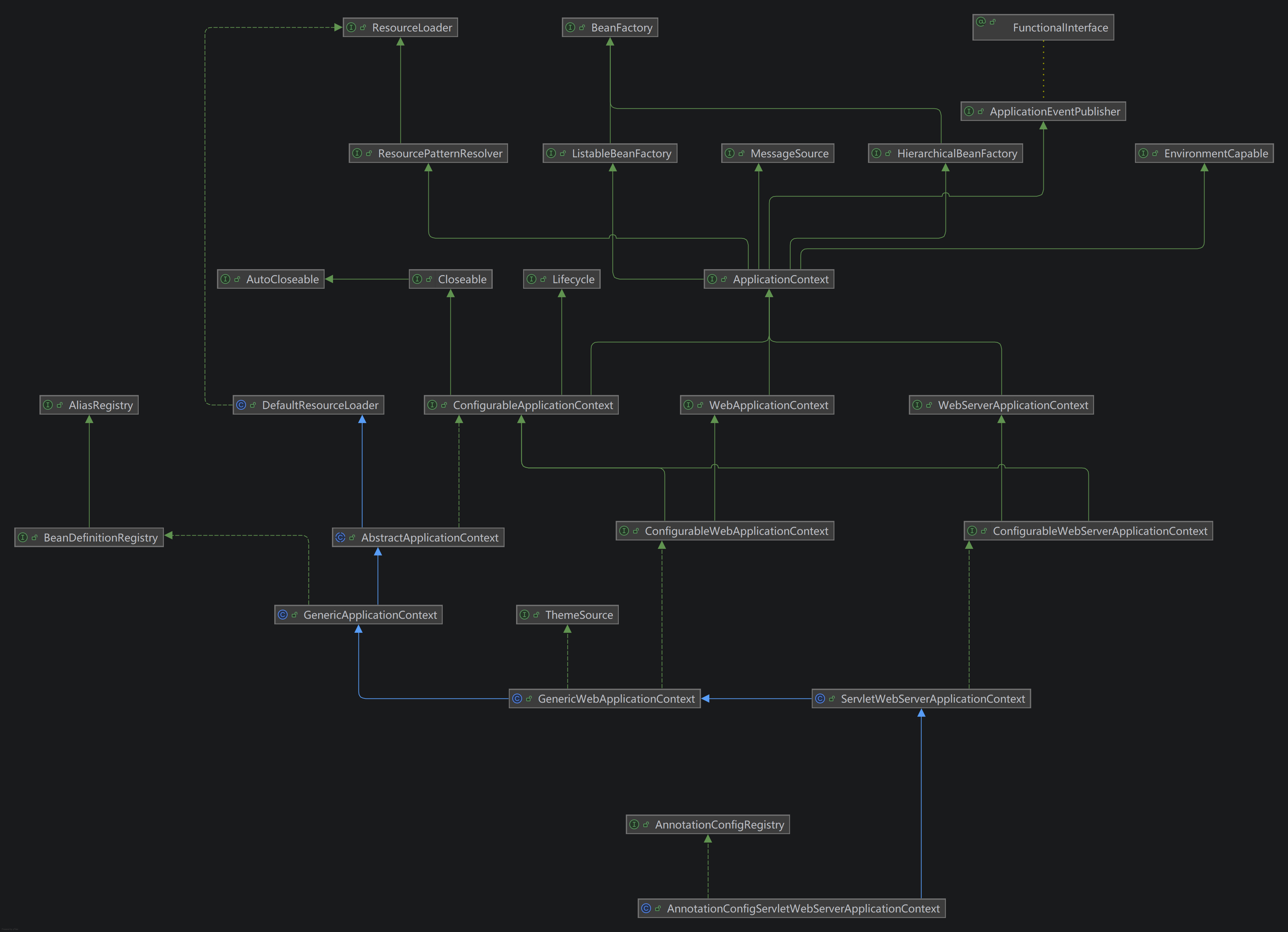
- BeanFactory(根 Bean 工厂接口)所有容器底层根基,提供基础 Bean 获取能力:getBean() 根据名称 / 类型获取 Bean;containsBean() 判断 Bean 是否存在。所有容器本质都是 BeanFactory。
- ListableBeanFactory extends BeanFactory:批量查询 Bean 能力:获取所有 Bean 名称、按类型批量获取 Bean
- ApplicationContext:Spring 容器顶级门面接口,整合全部能力:
- EnvironmentCapable:getEnvironment() 获取配置环境(PropertySource、yml、命令行参数)
- ResourcePatternResolver:加载 classpath、文件资源(扫描 @ComponentScan 资源底层)
- ApplicationEventPublisher:发布事件 publishEvent(),底层依赖 ApplicationEventMulticaster 广播事件
- MessageSource:国际化文本支持
- ConfigurableApplicationContext extends ApplicationContext + Lifecycle + Closeable 可手动配置、可启停、可关闭的容器接口,日常代码操作的标准接口:
- 扩展能力:refresh()、close()、registerShutdownHook()
- Lifecycle:start() / stop() 容器生命周期启停
- Closeable/AutoCloseable:支持 try-with-resources 自动关闭容器
- 可修改 BeanFactory、添加 PropertySource、注册后置处理器
- 启动流程里 context.refresh() 就是这个接口定义的方法。
- BeanDefinitionRegistry Bean 定义注册接口:
- registerBeanDefinition() 注册 Bean 元数据(@Component、@Bean 都会生成 BeanDefinition 注册到这里)
- removeBeanDefinition() 删除 Bean 定义
- GenericApplicationContext 实现该接口,也是注解扫描能注册 Bean 的基础。
- AbstractApplicationContext extends DefaultResourceLoader implements ConfigurableApplicationContext 整个 Spring 容器最核心的抽象父类,90% 启动逻辑都在这里,refresh() 12 步全在这个类中实现:
- prepareRefresh、invokeBeanFactoryPostProcessors、registerBeanPostProcessors、finishBeanFactoryInitialization
- 内置事件广播器、MessageSource、生命周期管理、关闭钩子
- 统一实现容器生命周期、事件发布、资源加载、环境持有
- 所有 ApplicationContext 最终都会继承它,只是重写少量 Web / 注解差异化逻辑。
- GenericApplicationContext extends AbstractApplicationContext implements BeanDefinitionRegistry 通用标准容器:
- 持有 beanFactory 字段,默认实现是 DefaultListableBeanFactory。
- 继承 AbstractApplicationContext,拥有完整 refresh 流程
- 实现 BeanDefinitionRegistry,可以手动注册 BeanDefinition
- 内置 DefaultListableBeanFactory(真正存放 BeanDefinition、单例池的工厂)
- 作用:非 Web 环境、单元测试、手动编码创建容器都用这个类。
- WebApplicationContext extends ApplicationContext:Web 容器标记接口,新增 Servlet 相关能力:getServletContext() 获取 Servlet 上下文,区分普通容器和 Web 容器。
- ConfigurableWebApplicationContext 传统外置 Tomcat 容器接口(SSM、war 包外置容器):绑定 ServletContext、ServletConfig,SpringBoot 内嵌容器不使用这个分支,走下面 WebServer 分支。
- WebServerApplicationContext SpringBoot 新增接口:内嵌 Web 容器专用标记 getWebServer() 获取内嵌 Tomcat/Jetty/WebServer 实例,只有 SpringBoot 自动创建的容器实现该接口。
- ConfigurableWebServerApplicationContext 可配置的内嵌 Web 容器标准接口:同时拥有可配置容器能力 + 获取内嵌 WebServer 能力,是 ServletWebServerApplicationContext 实现的接口
- ServletWebServerApplicationContext SpringBoot 内嵌 Servlet Web 容器基础父类(Tomcat/Jetty 底层父类),核心新增逻辑:
- 重写 onRefresh():创建内嵌 Tomcat 容器( refresh 流程第 8 步 onRefresh)
- 管理 WebServer 生命周期,容器刷新完成后启动 Tomcat
- 提供 Servlet 上下文、注册 DispatcherServlet 逻辑
- 适配 SpringBoot 自动配置的 Web 环境、server.port 等配置
- 所有内嵌 Servlet 容器公共逻辑全部封装在这里。
- 重点的几个类:
- BeanFactory,ApplicationContext,
BeanDefinition
BeanDefinition是 Bean 的元数据描述对象,不存 Bean 实例,只存怎么创建这个 Bean 的全部配置信息;- Spring 容器在
refresh()前期只会生成、存储大量 BeanDefinition,不会实例化 Bean;等到finishBeanFactoryInitialization才根据 BeanDefinition 反射创建 Bean 对象。 @Component、@Bean、@Configuration、@Conditional、@Scope、@Autowired全部先解析成 BeanDefinition,再统一处理。- 子接口:AnnotatedBeanDefinition:注解体系专用 BeanDefinition,SpringBoot 几乎所有业务 Bean 都实现这个接口。可以拿到该类上所有注解元数据(
AnnotationMetadata)
- 三大核心实现类(日常开发全部用到)
- GenericBeanDefinition(通用标准 Bean 定义)最通用实现,支持:
- XML 配置注册 Bean
@Bean配置类工厂方法生成 Bean- 手动编码注册自定义 Bean
- 可完整设置构造参数、属性、作用域、初始化方法,功能最全。
- AnnotatedBeanDefinitionReader 手动编码注册、启动类 / 配置类注册时使用。
- AnnotationMetadata 表示注解 @SpringApplication 等,可以判断类是否标注
@Configuration、读取@ComponentScan的扫描包、获取@Conditional条件; MethodMetadata:存储@Bean方法信息,返回类型、方法上注解、initMethod/destroyMethod。
- AnnotationMetadata 表示注解 @SpringApplication 等,可以判断类是否标注
- ScannedGenericBeanDefinition(包扫描产出)
@ComponentScan扫描@Component/@Service/@Repository/@Controller时生成的 BeanDefinition。- 实现 AnnotatedBeanDefinition,内置
AnnotationMetadata,方便读取类上注解(如@Conditional、@Scope)。 - 源码位置:
ComponentScanAnnotationParser扫描包后批量构建此类。
- RootBeanDefinition(框架内部底层 Bean)用于容器内置基础设施 Bean:
ConfigurationClassPostProcessorAutowiredAnnotationBeanPostProcessorPropertySourcesPlaceholderConfigurer- 不用于业务 Bean;不能作为父 BeanDefinition,代表完整独立根 Bean。
- ChildBeanDefinition(几乎废弃)早期 XML 父子 Bean 继承使用,注解开发基本不用。
- GenericBeanDefinition(通用标准 Bean 定义)最通用实现,支持:
各类注解如何转换成 BeanDefinition
- @Component / @Service / @Controller / @Repository
- 执行
ConfigurationClassPostProcessor→ComponentScanAnnotationParser - 扫描指定包,生成
ScannedGenericBeanDefinition,存入 BeanDefinitionRegistry。 - 自动读取类上
@Scope、@Primary、@Conditional写入 BeanDefinition 属性。
- @Configuration + @Bean
- 解析配置类时,对每个 @Bean 工厂方法生成
GenericBeanDefinition; - 记录工厂类、工厂方法名、返回类型、initMethod/destroyMethod。
- @Import / ImportBeanDefinitionRegistrar
- 手动调用
registry.registerBeanDefinition()自定义注册 BeanDefinition(Mybatis、Feign 大量使用)。
- @Conditional 系列注解
- 解析 BeanDefinition 时判断条件,不满足直接丢弃该 BeanDefinition,不会注册到工厂。
tip
BeanFactoryPostProcessor:所有 BeanDefinition 注册完成后、Bean 实例化之前,统一修改 BeanDefinition;典型:PropertySourcesPlaceholderConfigurer处理${}占位符。BeanDefinitionRegistryPostProcessor:比上面更早,可以新增、删除 BeanDefinition;核心实现:ConfigurationClassPostProcessor(扫描、解析配置类全靠它)。注意:BeanPostProcessor 操作的是实例化后的 Bean 对象,不操作 BeanDefinition,不要混淆。
回到run方法
- 准备容器
prepareContext(bootstrapContext, context, environment, listeners, applicationArguments, printedBanner);
// 把前面 prepareEnvironment() 构建好的完整环境绑定到容器
context.setEnvironment(environment);
// 容器的后置处理
postProcessApplicationContext(context);
// 执行所有 ApplicationContextInitializer:spring.factories 中配置的 SPI 扩展;SpringApplication.addInitializers() 手动添加的自定义初始化器。
applyInitializers(context);
// 发布容器准备好事件
listeners.contextPrepared(context);
// 发布引导上下文关闭事件
bootstrapContext.close(context);
// 把命令行参数注册为bean
beanFactory.registerSingleton("springApplicationArguments", applicationArguments);
// 注册banner
beanFactory.registerSingleton("springBootBanner", printedBanner);
// beanFactory后置处理器,把 defaultProperties 放在最低优先级
context.addBeanFactoryPostProcessor(new PropertySourceOrderingBeanFactoryPostProcessor(context));
// 注册启动主类
load(context, sources.toArray(new Object[0]));
// 发布上下文加载事件
listeners.contextLoaded(context);
- 注册启动主类
load(context, sources.toArray(new Object[0])); - bean定义加载器
createBeanDefinitionLoader(getBeanDefinitionRegistry(context), sources);从sources 中加载bean定义,是一个门面,内部有 AnnotatedBeanDefinitionReader, XmlBeanDefinitionReader, ClassPathBeanDefinitionScanner. - 实际由
AnnotatedBeanDefinitionReader#register(Class<?>... componentClasses)方法注册,内部调用AnnotatedBeanDefinitionReader#doRegisterBean - 内部创建 AnnotatedGenericBeanDefinition
// 生成bean名称:myApplication
this.beanNameGenerator.generateBeanName(abd, this.registry);
// 处理其他的注解信息,写入 AnnotatedGenericBeanDefinition,包括 @Lazy, @Primary, @DependsOn, @Role, @Description
AnnotationConfigUtils.processCommonDefinitionAnnotations(abd);
// bean定义持有者,有beanDefinition,bena名称,别名(默认为null)
BeanDefinitionHolder definitionHolder = new BeanDefinitionHolder(abd, beanName);
// 设置代理,目前默认无代理
definitionHolder = AnnotationConfigUtils.applyScopedProxyMode(scopeMetadata, definitionHolder, this.registry);
// 注册beanDefintion,调用 beanFactory 的 registerBeanDefinition(String beanName, BeanDefinition beanDefinition)
// 存入 Map<String, BeanDefinition> beanDefinitionMap
// 同时把bean名称存入 List<String> beanDefinitionNames
BeanDefinitionReaderUtils.registerBeanDefinition(definitionHolder, this.registry);
刷新上下文
- refreshContext(ConfigurableApplicationContext context)
- 首先加入应用关闭钩子
shutdownHook.registerApplicationContext(context); - 注入应用关闭监听器
context.addApplicationListener(this.contextCloseListener); - 实际的刷新是在
AbstractApplicationContext#refresh()执行 - 内部加锁
synchronized (this.startupShutdownMonitor)一旦触发异常,整个应用启动失败
整体流程
prepareRefresh()—— 容器刷新前置准备
- 标记容器状态为激活,校验环境合法性;
- 初始化早期事件集合、资源属性;
- 清空本地缓存,为后续 Bean 解析做准备;
- 无 Bean 工厂、无 Bean 相关操作,仅基础状态初始化。
obtainFreshBeanFactory()—— 获取 / 刷新底层 Bean 工厂
- 返回可配置 Bean 工厂
ConfigurableListableBeanFactory,这是存放所有BeanDefinition、单例池的底层仓库; - 产出:整个容器唯一的 Bean 工厂实例。
prepareBeanFactory(beanFactory)—— 配置 Bean 工厂基础能力
- 给工厂统一装配内置基础设施:
- 绑定容器类加载器、表达式解析器;
- 注册内置环境 Bean:
Environment、系统属性、系统环境; - 注册内置属性编辑器(类型转换基础);
- 添加
ApplicationContextAwareProcessor,后续处理*Aware接口注入; - 设置容器内置
ConversionService类型转换服务;
- 此时工厂只有基础内置 Bean,还没有业务 Bean 定义。
postProcessBeanFactory(beanFactory)—— 子类扩展 Bean 工厂
- 模板方法,Web 容器专属重写:
- ServletWeb 容器注册
request/session等 Web 作用域; - 普通非 Web 容器空实现;
- 允许子类对 BeanFactory 做自定义增强。
invokeBeanFactoryPostProcessors(beanFactory)—— 处理所有 Bean 定义后置处理器【注解扫描核心】
- 分两类处理器依次执行,所有 BeanDefinition 在这里全部生成完成:
BeanDefinitionRegistryPostProcessor(优先执行) 核心实现ConfigurationClassPostProcessor: 扫描@ComponentScan、解析@Configuration/@Bean/@Import/@EnableAutoConfiguration,生成并注册全部业务 BeanDefinition;BeanFactoryPostProcessor处理配置占位符${xxx}、修改已存在的 BeanDefinition;
- 阶段成果:项目所有类、配置、自动配置全部解析为 Bean 定义存入工厂,但是没有任何 Bean 实例。
registerBeanPostProcessors(beanFactory)—— 注册 Bean 创建拦截器
- 扫描所有
BeanPostProcessor并按优先级排序注册到工厂: AutowiredAnnotationBeanPostProcessor:处理@Autowired/@Value注入;CommonAnnotationBeanPostProcessor:处理@Resource/@PostConstruct;AnnotationAwareAspectJAutoProxyCreator:AOP 代理创建;- 作用:后面实例化 Bean 时,会自动执行这些拦截器做注入、代理;
- 只注册,不执行,执行时机在 Bean 创建阶段。
initMessageSource()—— 初始化国际化资源
- 创建内置
MessageSourceBean,支持多语言配置读取,业务很少用到。
initApplicationEventMulticaster()—— 初始化事件广播器
- 创建容器全局事件分发器
ApplicationEventMulticaster,支撑publishEvent()、@EventListener事件体系; - 没有自定义则创建默认同步广播器。
onRefresh()—— 子类专属刷新逻辑(SpringBoot 内嵌 Tomcat 关键)
- 模板方法,Web 容器重写此方法:
ServletWebServerApplicationContext在这里创建内嵌 Tomcat/Jetty WebServer; - 非 Web 容器空实现。
registerListeners()—— 注册所有事件监听器
- 注册框架内置硬编码监听器;
- 从 Bean 工厂找出所有
ApplicationListener实现类,注册到事件广播器;
- 从 Bean 工厂找出所有
- 解析所有
@EventListener注解方法,封装成监听器;
- 解析所有
- 容器后续发布事件时,可以找到所有监听者。
finishBeanFactoryInitialization(beanFactory)—— 实例化所有非懒加载单例 Bean【依赖注入核心】
- 遍历全部 BeanDefinition,一次性创建所有单例、非抽象、非懒加载 Bean,完整生命周期:
- 构造器实例化 → 字段 /setter 注入(@Autowired) → 执行初始化方法 (
@PostConstruct/afterPropertiesSet) → 存入单例池; - 循环解决单例字段循环依赖;
- 执行完这一步,所有业务 Bean 全部实例化完成,可直接 getBean 使用。
finishRefresh()—— 容器收尾,发布就绪事件
- 初始化生命周期处理器;
- 启动所有实现
Lifecycle的 Bean;
- 启动所有实现
- 发布核心事件
ContextRefreshedEvent;
- 发布核心事件
- 启动内嵌 Web 服务器(Tomcat 正式监听端口,对外提供 HTTP 服务);
- 容器彻底就绪。
- 异常 catch 块
- 任意步骤抛出 Bean 相关异常:
- 销毁已经创建成功的单例 Bean,释放资源;
- 标记容器刷新失败,重置激活状态;
- 向上抛出异常,终止应用启动。
- finally 块
- 清空 Spring 内部反射、注解元数据缓存,释放内存;结束本次刷新的 StartupStep 耗时埋点。
逐步解析
prepareRefresh
AbstractApplicationContext#prepareRefreshstartupDate:记录本次容器刷新的时间戳,后续打印启动耗时用;closed.set(false):把容器关闭标记置为 false,代表容器不再是关闭状态;active.set(true):标记容器为激活中,避免并发多次调用 refresh ()。initPropertySources()初始化环境占位资源(目前没有执行什么操作)getEnvironment().validateRequiredProperties();校验必填配置项(目前是空的)- 缓存刷新前的内置监听器
earlyApplicationListeners - 创建早期事件缓存集合
earlyApplicationEvents,早期还无法发布事件,先缓存后面再发布
obtainFreshBeanFactory
setSerializationId实际是MyApplication- 返回的 beanFactory 还是 context 中的 beanFactory (DefaultListableBeanFactory)
prepareBeanFactory
-
beanFactory.setBeanClassLoader(getClassLoader());设置 bean 的类加载器,默认是线程上下文类加载器 -
注册 SpEL 解析器,支持
#{...}对象表达式(@Value("#{bean.xxx}")); -
注册资源编辑器,自动把字符串路径转为
Resource、File、URL等类型。 -
beanFactory.addBeanPostProcessor(new ApplicationContextAwareProcessor(this));Bean 创建后回调所有XXXAware接口,给 Bean 注入容器内置对象; -
beanFactory.ignoreDependencyInterface(XXXAware.class);告诉工厂不要通过自动注入填充这些 Aware 接口,统一由上面的后置处理器手动赋值,避免重复注入冲突。ApplicationContextAwareProcessor#postProcessBeforeInitialization会注入EnvironmentAware、ResourceLoaderAware、ApplicationEventPublisherAware、ApplicationContextAware等 -
beanFactory.registerResolvableDependency(BeanFactory.class, beanFactory);注册可直接自动注入的内置依赖(registerResolvableDependency),效果是业务 Bean 可以直接@Autowired注入ApplicationContext, ApplicationEventPublisher等 bean。内部存入this.resolvableDependencies.put(dependencyType, autowiredValue) -
beanFactory.addBeanPostProcessor(new ApplicationListenerDetector(this));注册监听器探测器 ApplicationListenerDetector,凡是实现ApplicationListener的 Bean,实例化完成后自动注册到事件广播器,不用手动配置。 -
手动注册 4 个固定名称单例,全项目任意 Bean 可直接注入:
environment→ ConfigurableEnvironment 读取配置、yml、命令行参数systemProperties→ JVM 系统属性systemEnvironment→ 操作系统环境变量applicationStartup→ 启动耗时埋点工具
-
注册单例 bean 在
DefaultSingletonBeanRegistry#registerSingleton(String beanName, Object singletonObject),内部存储在Map<String, Object> singletonObjects,Set<String> registeredSingletons存储注册的单例 bean 的名称
postProcessBeanFactory
super.postProcessBeanFactory(beanFactory);中调用 ServletWebServerApplicationContext#postProcessBeanFactory 添加 WebApplicationContextServletContextAwareProcessor 后置处理器,设置 servletContext 和 servletConfigregisterWebApplicationScopes();注入 ServletRequest,ServletResponse,HttpSession,WebRequest
this.scanner.scan(this.basePackages);扫描预设基础包 basePackages,SpringBoot 正常场景不会走这里basePackages:通过代码手动指定的扫描包路径;- 只有手动调用
context.scan("com.xxx")时,basePackages 才会赋值
this.reader.register(ClassUtils.toClassArray(this.annotatedClasses));注册手动添加的注解类 annotatedClasses,也不会走到这里- 只有手动调用
context.register(Class.class)时,annotatedClasses 才会赋值
- 只有手动调用
invokeBeanFactoryPostProcessors
- BeanDefinitionRegistryPostProcessor extends BeanFactoryPostProcessor
- 独有方法:
postProcessBeanDefinitionRegistry(registry) - 能力:新增、删除、修改 BeanDefinition(最核心,包扫描、自动配置全靠它)
- 独有方法:
- BeanFactoryPostProcessor
- 方法:
postProcessBeanFactory(beanFactory) - 能力:只能修改已经存在的 BeanDefinition,不能新增 Bean
- 方法:
-
先执行外部手动传入的 BeanDefinitionRegistryPostProcessor,来自 AbstractApplicationContext.beanFactoryPostProcessors,来源
- CachingMetadataReaderFactoryPostProcessor:在 prepareContext#applyInitializers 时通过 spring.factores ApplicationContextInitializer SPI 注入,其中 SharedMetadataReaderFactoryContextInitializer 的 initialize 方法添加该后置处理器。其 postProcessBeanDefinitionRegistry 注入名为
org.springframework.boot.autoconfigure.internalCachingMetadataReaderFactory的 bean 定义,是个 rootBeanDefinition - ConfigurationWarningsPostProcessor:也是在 prepareContext#applyInitializers 作为 ApplicationContextInitializer SPI 注入
- PropertySourceOrderingBeanFactoryPostProcessor:在 prepareContext 中显示注入
context.addBeanFactoryPostProcessor(new PropertySourceOrderingBeanFactoryPostProcessor(context))
- CachingMetadataReaderFactoryPostProcessor:在 prepareContext#applyInitializers 时通过 spring.factores ApplicationContextInitializer SPI 注入,其中 SharedMetadataReaderFactoryContextInitializer 的 initialize 方法添加该后置处理器。其 postProcessBeanDefinitionRegistry 注入名为
-
然后处理容器内 BeanDefinitionRegistryPostProcessor,按照实现
PriorityOrdered,实现Ordered和剩下无排序的分三批执行invokeBeanDefinitionRegistryPostProcessors,内部执行 postProcessBeanDefinitionRegistry 完成Bean 定义注册; -
然后执行 BeanDefinitionRegistryPostProcessor 的 postProcessBeanFactory 方法,然后是手动传入的普通 BeanFactoryPostProcessor 的 postProcessBeanFactory 方法。processedBeans 记录已处理的 bean 名称
-
再执行容器内普通 BeanFactoryPostProcessor,过滤掉上一步已经处理过的处理器,也是按照三种优先级执行
- 首先执行 ConfigurationClassPostProcessor,第三方框架的 com.example.com.MyApplication#MapperScannerRegistrar#0,dubbo等
- 然后 PropertySourcesPlaceholderConfigurer,DatabaseInitializationDependencyConfigurer$DependsOnDatabaseInitializationPostProcessor,EventListenerProcessor
ConfigurationClassPostProcessor#processConfigBeanDefinitions
-
configCandidates 只有 MyApplication
-
进入
ConfigurationClassParser#doProcessConfigurationClass(ConfigurationClass configClass, SourceClass sourceClass, Predicate<String> filter),configClass 是配置类对象(加了@Configuration的),sourceClass 是原始类 -
判断是否添加 @Component 注解
-
处理 @PropertySource 注解
-
处理 @ComponentScan 注解,执行扫描,进入 ComponentScanAnnotationParser#parse,创建 ClassPathBeanDefinitionScanner,根据 @ComponentScan 一系列属性,设置ClassPathBeanDefinitionScanner 的属性,进入其 doScan 方法,扫描启动类所在包下的类。
- 进入 findCandidateComponents(basePackage) -> ClassPathScanningCandidateComponentProvider#scanCandidateComponents 获取包下的所有类,对每个类处理,得到 ScannedGenericBeanDefinition
- 对每个 BeanDefinition 执行 postProcessBeanDefinition((AbstractBeanDefinition) candidate, beanName); AnnotationConfigUtils.processCommonDefinitionAnnotations((AnnotatedBeanDefinition) candidate); 设置其他相关属性。最后注册到容器内
- 对每个 BeanDefinitionHolder 递归解析
-
处理 @Import 注解,找到 sourceClass 上的注解的注解递归找 @Import 导入的类
- 反射创建 ImportSelector 执行其 selectImports 方法
-
处理 @ImportResource 注解
-
处理 @Bean,retrieveBeanMethodMetadata(sourceClass); 获取所有 @Bean 方法,构造 BeanMethod 加入 configClass 中
-
处理接口上的 @Bean 方法
-
返回其父类,接着处理 doProcessConfigurationClass
-
this.deferredImportSelectorHandler.process(); 处理自动配置的 selector
-
this.reader.loadBeanDefinitions(configClasses); 获取所有的配置类后,加载bean定义,进入 ConfigurationClassBeanDefinitionReader#loadBeanDefinitionsForConfigurationClass
- 默认的所有 META-INF/spring.factories 的内容
org.springframework.boot.autoconfigure.AutoConfigurationImportListener=[org.springframework.boot.autoconfigure.condition.ConditionEvaluationReportAutoConfigurationImportListener]
org.springframework.boot.diagnostics.FailureAnalysisReporter=[org.springframework.boot.diagnostics.LoggingFailureAnalysisReporter]
org.springframework.boot.ApplicationContextFactory=[org.springframework.boot.web.reactive.context.AnnotationConfigReactiveWebServerApplicationContext.Factory, org.springframework.boot.web.servlet.context.AnnotationConfigServletWebServerApplicationContext.Factory]
org.springframework.boot.SpringApplicationRunListener=[org.springframework.boot.context.event.EventPublishingRunListener]
org.springframework.beans.BeanInfoFactory=[org.springframework.beans.ExtendedBeanInfoFactory]
org.springframework.boot.autoconfigure.template.TemplateAvailabilityProvider=[org.springframework.boot.autoconfigure.freemarker.FreeMarkerTemplateAvailabilityProvider, org.springframework.boot.autoconfigure.mustache.MustacheTemplateAvailabilityProvider, org.springframework.boot.autoconfigure.groovy.template.GroovyTemplateAvailabilityProvider, org.springframework.boot.autoconfigure.thymeleaf.ThymeleafTemplateAvailabilityProvider, org.springframework.boot.autoconfigure.web.servlet.JspTemplateAvailabilityProvider]
org.springframework.context.ApplicationListener=[org.springframework.boot.ClearCachesApplicationListener, org.springframework.boot.builder.ParentContextCloserApplicationListener, org.springframework.boot.context.FileEncodingApplicationListener, org.springframework.boot.context.config.AnsiOutputApplicationListener, org.springframework.boot.context.config.DelegatingApplicationListener, org.springframework.boot.context.logging.LoggingApplicationListener, org.springframework.boot.env.EnvironmentPostProcessorApplicationListener, org.springframework.boot.autoconfigure.BackgroundPreinitializer]
org.springframework.boot.logging.LoggingSystemFactory=[org.springframework.boot.logging.logback.LogbackLoggingSystem.Factory, org.springframework.boot.logging.log4j2.Log4J2LoggingSystem.Factory, org.springframework.boot.logging.java.JavaLoggingSystem.Factory]
org.springframework.boot.sql.init.dependency.DatabaseInitializerDetector=[org.springframework.boot.flyway.FlywayDatabaseInitializerDetector, org.springframework.boot.jdbc.AbstractDataSourceInitializerDatabaseInitializerDetector, org.springframework.boot.jdbc.init.DataSourceScriptDatabaseInitializerDetector, org.springframework.boot.liquibase.LiquibaseDatabaseInitializerDetector, org.springframework.boot.orm.jpa.JpaDatabaseInitializerDetector, org.springframework.boot.r2dbc.init.R2dbcScriptDatabaseInitializerDetector, org.springframework.boot.autoconfigure.flyway.FlywayMigrationInitializerDatabaseInitializerDetector]
org.springframework.boot.env.PropertySourceLoader=[org.springframework.boot.env.PropertiesPropertySourceLoader, org.springframework.boot.env.YamlPropertySourceLoader]
org.springframework.boot.autoconfigure.AutoConfigurationImportFilter=[org.springframework.boot.autoconfigure.condition.OnBeanCondition, org.springframework.boot.autoconfigure.condition.OnClassCondition, org.springframework.boot.autoconfigure.condition.OnWebApplicationCondition]
org.springframework.boot.diagnostics.FailureAnalyzer=[org.springframework.boot.context.config.ConfigDataNotFoundFailureAnalyzer, org.springframework.boot.context.properties.IncompatibleConfigurationFailureAnalyzer, org.springframework.boot.context.properties.NotConstructorBoundInjectionFailureAnalyzer, org.springframework.boot.diagnostics.analyzer.BeanCurrentlyInCreationFailureAnalyzer, org.springframework.boot.diagnostics.analyzer.BeanDefinitionOverrideFailureAnalyzer, org.springframework.boot.diagnostics.analyzer.BeanNotOfRequiredTypeFailureAnalyzer, org.springframework.boot.diagnostics.analyzer.BindFailureAnalyzer, org.springframework.boot.diagnostics.analyzer.BindValidationFailureAnalyzer, org.springframework.boot.diagnostics.analyzer.UnboundConfigurationPropertyFailureAnalyzer, org.springframework.boot.diagnostics.analyzer.MutuallyExclusiveConfigurationPropertiesFailureAnalyzer, org.springframework.boot.diagnostics.analyzer.NoSuchMethodFailureAnalyzer, org.springframework.boot.diagnostics.analyzer.NoUniqueBeanDefinitionFailureAnalyzer, org.springframework.boot.diagnostics.analyzer.PortInUseFailureAnalyzer, org.springframework.boot.diagnostics.analyzer.ValidationExceptionFailureAnalyzer, org.springframework.boot.diagnostics.analyzer.InvalidConfigurationPropertyNameFailureAnalyzer, org.springframework.boot.diagnostics.analyzer.InvalidConfigurationPropertyValueFailureAnalyzer, org.springframework.boot.diagnostics.analyzer.PatternParseFailureAnalyzer, org.springframework.boot.liquibase.LiquibaseChangelogMissingFailureAnalyzer, org.springframework.boot.web.context.MissingWebServerFactoryBeanFailureAnalyzer, org.springframework.boot.web.embedded.tomcat.ConnectorStartFailureAnalyzer, org.springframework.boot.autoconfigure.data.redis.RedisUrlSyntaxFailureAnalyzer, org.springframework.boot.autoconfigure.diagnostics.analyzer.NoSuchBeanDefinitionFailureAnalyzer, org.springframework.boot.autoconfigure.flyway.FlywayMigrationScriptMissingFailureAnalyzer, org.springframework.boot.autoconfigure.jdbc.DataSourceBeanCreationFailureAnalyzer, org.springframework.boot.autoconfigure.jdbc.HikariDriverConfigurationFailureAnalyzer, org.springframework.boot.autoconfigure.jooq.NoDslContextBeanFailureAnalyzer, org.springframework.boot.autoconfigure.r2dbc.ConnectionFactoryBeanCreationFailureAnalyzer, org.springframework.boot.autoconfigure.r2dbc.MissingR2dbcPoolDependencyFailureAnalyzer, org.springframework.boot.autoconfigure.r2dbc.MultipleConnectionPoolConfigurationsFailureAnalyzer, org.springframework.boot.autoconfigure.r2dbc.NoConnectionFactoryBeanFailureAnalyzer, org.springframework.boot.autoconfigure.session.NonUniqueSessionRepositoryFailureAnalyzer]
org.springframework.boot.SpringBootExceptionReporter=[org.springframework.boot.diagnostics.FailureAnalyzers]
org.springframework.boot.sql.init.dependency.DependsOnDatabaseInitializationDetector=[org.springframework.boot.sql.init.dependency.AnnotationDependsOnDatabaseInitializationDetector, org.springframework.boot.jdbc.SpringJdbcDependsOnDatabaseInitializationDetector, org.springframework.boot.jooq.JooqDependsOnDatabaseInitializationDetector, org.springframework.boot.orm.jpa.JpaDependsOnDatabaseInitializationDetector, org.springframework.boot.autoconfigure.batch.JobRepositoryDependsOnDatabaseInitializationDetector, org.springframework.boot.autoconfigure.quartz.SchedulerDependsOnDatabaseInitializationDetector, org.springframework.boot.autoconfigure.session.JdbcIndexedSessionRepositoryDependsOnDatabaseInitializationDetector]
org.springframework.boot.context.config.ConfigDataLocationResolver=[org.springframework.boot.context.config.ConfigTreeConfigDataLocationResolver, org.springframework.boot.context.config.StandardConfigDataLocationResolver]
org.springframework.context.ApplicationContextInitializer=[org.springframework.boot.context.ConfigurationWarningsApplicationContextInitializer, org.springframework.boot.context.ContextIdApplicationContextInitializer, org.springframework.boot.context.config.DelegatingApplicationContextInitializer, org.springframework.boot.rsocket.context.RSocketPortInfoApplicationContextInitializer, org.springframework.boot.web.context.ServerPortInfoApplicationContextInitializer, org.springframework.boot.autoconfigure.SharedMetadataReaderFactoryContextInitializer, org.springframework.boot.autoconfigure.logging.ConditionEvaluationReportLoggingListener]
org.springframework.boot.env.EnvironmentPostProcessor=[org.springframework.boot.cloud.CloudFoundryVcapEnvironmentPostProcessor, org.springframework.boot.context.config.ConfigDataEnvironmentPostProcessor, org.springframework.boot.env.RandomValuePropertySourceEnvironmentPostProcessor, org.springframework.boot.env.SpringApplicationJsonEnvironmentPostProcessor, org.springframework.boot.env.SystemEnvironmentPropertySourceEnvironmentPostProcessor, org.springframework.boot.reactor.DebugAgentEnvironmentPostProcessor, org.springframework.boot.autoconfigure.integration.IntegrationPropertiesEnvironmentPostProcessor]
org.springframework.boot.context.config.ConfigDataLoader=[org.springframework.boot.context.config.ConfigTreeConfigDataLoader, org.springframework.boot.context.config.StandardConfigDataLoader]